

UiPath-ADPv1 Dumps 2025 - New UiPath UiPath-ADPv1 Exam Questions
Free UiPath-ADPv1 braindumps download (UiPath-ADPv1 exam dumps Free Updated)
NEW QUESTION # 28
While troubleshooting a process developed using the Robotic Enterprise (RE) Framework, you have placed a breakpoint at the "Invoke InitAllSettings" workflow activity.
Given the current state of the Executor, what will occur when you click on the Step Over button?
- A. Executor directs to the "If in_OrchestratorQ ... " activity
- B. Executor directs to the first InitAllSettings workflow activity
- C. Executor directs to the first activity outside "If first run, read local configuration"
- D. Executor directs to the "First Run" sequence
Answer: A
Explanation:
When a breakpoint is placed at a particular activity within the workflow and the Step Over function is used, the Executor will move to the next activity in the sequence. Given the context of the REFramework, after stepping over the "Invoke InitAllSettings" workflow, the next activity that would execute is the "If in_OrchestratorQueueName ..." activity, assuming there are no activities in between within the
"InitAllSettings" workflow itself. Step Over will not go into the invoked workflow but will move to the next activity at the same level of the workflow where the breakpoint was placed.
References:
* UiPath Studio Guide: Debugging
NEW QUESTION # 29
What is the correct execution order of the State activity sections?
instructions: Drag the Description found on the "Left" and drop on the correct Execution Order found on the
"Right"
Answer:
Explanation:

NEW QUESTION # 30
In the context of a process automated using the REFramework that processes payments and sends a report using the Finance team leader's email account at the end of the day. where should the email account credentials be stored according to best practices''
- A. In an Orchestrator Credential asset and referenced in the Settings sheet in the Config.xlsx file.
- B. In an Orchestrator Text asset and referenced in the Assets sheet In the Config.xlsx file.
- C. In an Orchestrator Credential asset and referenced in the Assets sheet in the Config.xlsx file.
- D. In the Constants sheet in the Config.xlsx file with the value of the email address.
Answer: C
Explanation:
In the REFramework, best practices suggest storing sensitive information like email account credentials in an Orchestrator Credential asset. This asset is then referenced in the Config.xlsx file, specifically in the Assets sheet, ensuring secure and centralized management of credentials.
NEW QUESTION # 31
Which of the following describes the correct hierarchy of the elements in the Object Repository tree structure?
- A. Screen, Application, Version, Ul Element.
- B. Application, Screen, Ul Element, Version.
- C. Version, Application, Screen, Ul Element.
- D. Application, Version, Screen, Ul Element.
Answer: B
NEW QUESTION # 32
When building automation projects, which statement is true regarding Perform Remote Debugging?
- A. Perform Remote Debugging enables developers to design new III elements for the automation project.
- B. Perform Remote Debugging allows developers to debug a project on a different machine using a web- based interface.
- C. Perform Remote Debugging is only possible when the automation project does not involve Orchestrator queues and assets.
- D. Perform Remote Debugging refers to the process of testing and debugging an automation project on the same machine where UiPath Studio is installed.
Answer: B
Explanation:
Comprehensive and Detailed Explanation: Remote Debugging is a feature of UiPath Studio that allows developers to run and debug automation projects on robots deployed to remote machines, including on Linux robots that can run cross-platform projects1. It enables developers to connect to the remote robot using either a remote machine connection or an unattended robot connection, and then use the Studio debugging tools to inspect the execution and troubleshoot any issues1. Remote Debugging uses a web-based interface that shows the UI elements and the data of the remote machine, as well as the breakpoints, variables, and output of the project2.
The other options are incorrect because:
* Option A is incorrect because Remote Debugging is not limited by the involvement of Orchestrator queues and assets in the automation project. Remote Debugging can work with any project that can be executed by a robot on a remote machine, regardless of the Orchestrator entities used1.
* Option B is incorrect because Remote Debugging does not enable developers to design new UI elements for the automation project. Remote Debugging is only used for testing and debugging existing projects, not for creating or modifying them1.
* Option C is incorrect because Remote Debugging does not refer to the process of testing and debugging an automation project on the same machine where UiPath Studio is installed. That process is called Local Debugging, which is the default debugging mode in Studio3.
References:
* Studio - Remote Debugging - UiPath Documentation Portal
* Remote Debugging in UiPath Studio - Video Tutorials - UiPath Community Forum
* Studio - Debugging Actions - UiPath Documentation Portal
NEW QUESTION # 33
What is the main function of the UiPath Remote Runtime component?
- A. It facilitates the communication between a remote application or desktop and the dedicated UiPath extension, allowing selectors to be natively generated in UiExplorer.
- B. It enables the use of OCR and image recognition activities on remote applications or desktops, without any extensions, allowing selectors to be natively generated in UiExplorer.
- C. It allows automations to run on the user machine, in a different Windows session.
- D. It introduces support for headless browser automation, so browser automation doesn't necessarily have to rely on visual elements on screen, such as window frames.
Answer: A
Explanation:
The UiPath Remote Runtime component is a component that facilitates the communication between a remote application or desktop, such as Citrix Virtual Apps, and the dedicated UiPath extension - the UiPath Extension for Citrix, the UiPath Extension for Windows Remote Desktop and Apps, or the UiPath Extension for VMware Horizon1. It gathers information about the targeted UI elements of the remote applications and sends them to the corresponding extension, so that selectors are natively generated in UiExplorer1. The UiPath Remote Runtime component is required to establish the connection between an application or desktop server and a corresponding UiPath extension installed on a client machine, where Studio is installed1. This way, selectors are natively generated on the client machine, without having to rely on OCR and image recognition activities1. .
NEW QUESTION # 34
What are the four job types present in the Job Type field according to the place of execution and robot impersonation?
- A. Foreground unattended, Background unattended. Attended, Development.
- B. Service unattended. Personal remote, Attended. Development.
- C. Service unattended, User remote. Attended, Debugging.
- D. Orchestrator unattended, Personal remote, User attended, Studio.
Answer: A
Explanation:
In UiPath, the four job types according to the place of execution and robot impersonation are Foreground unattended, Background unattended, Attended, and Development. These job types differentiate the automation tasks based on whether they require user interaction (Attended), can run in the background without user intervention (Background unattended), are designed for development and testing purposes (Development), or are unattended tasks that require a virtual environment (Foreground unattended).References:
UiPath Orchestrator Guide: Job Types
NEW QUESTION # 35
Considering that the attached table is stored in a variable called "dt":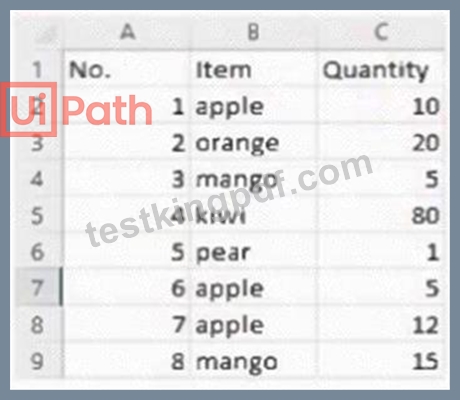
Which LINQ query can be used to return the maximum total Quantity?
- A. dt.AsEnumerable. Max(Function(x) Convert.ToInt32(x("Quantity").ToString))
- B. dt.AsEnumerable. Max(Function(x) Convert.ToInt32(x("Quantity").ToString))("Item")
- C. dt.AsEnumerable. OrderByDescending(Function(x) Convert.ToInt32(x("Quantity").ToString)).First.Item("Quantity")
- D. dt.AsEnumerable. GroupBy(Function(x) x("Item").ToString). Max(Function(x) x.Sum(Function(y) Convert.ToInt32(y("Quantity").ToString)))
Answer: D
Explanation:
The LINQ query that can be used to return the maximum total Quantity from the attached table is dt.AsEnumerable. GroupBy(Function(x) x("Item").ToString). Max(Function(x) x.Sum(Function(y) Convert.ToInt32(y("Quantity").ToString))). This query uses the LINQ methods AsEnumerable, GroupBy, Max, and Sum to manipulate the data in the dt variable. The dt variable is a DataTable that contains the following data:
No.
Item
Quantity
1
apple
10
2
orange
20
3
mango
50
4
kiwi
80
5
pear
1
6
apple
5
7
mango
15
The AsEnumerable method converts the DataTable into an Enumerable collection of DataRow objects. The GroupBy method groups the elements of the collection by the value of the Item column, creating a collection of groups. Each group has a key, which is the Item name, and a list of elements, which are the DataRows that have the same Item value. The Max method returns the maximum value of the collection, based on a selector function. The selector function is a lambda expression that calculates the sum of the Quantity column for each group. The Sum method returns the sum of the elements in a collection, based on a selector function. The selector function is a lambda expression that converts the value of the Quantity column into an integer.
Therefore, the query will group the DataRows by the Item name, calculate the total Quantity for each group, and return the maximum total Quantity among the groups. The maximum total Quantity is 80, which corresponds to the group with the key "kiwi". References: [DataTable.AsEnumerable Method],
[Enumerable.GroupBy Method], [Enumerable.Max Method], [Enumerable.Sum Method]
NEW QUESTION # 36
What is the correct sequence of steps in a REFramework project that is linked to Orchestrator it an application exception occurs on a Queue Item m the Process Transaction stale?
Instructions: Drag the Description found on the "Left" and drop on the correct Step Sequence found on the Right".
Answer:
Explanation:
Explanation:
NEW QUESTION # 37
What is the correct sequence of steps in a REFramework project that is linked to Orchestrator it an application exception occurs on a Queue Item m the Process Transaction stale?
Instructions: Drag the Description found on the "Left" and drop on the correct Step Sequence found on the Right".
Answer:
Explanation:

NEW QUESTION # 38
Which of the following best describes the Alerts panel?
- A. A panel that displays a more comprehensive list of all alerts.
- B. A panel that displays the most severe five alerts, accessible from the Alerts bell.
- C. A panel that displays alerts as they occur.
- D. A panel that displays summaries of the alerts you subscribed to, received as error reports every ten minutes, or as daily reports.
Answer: D
Explanation:
The Alerts panel in UiPath is a feature designed to notify users about different types of alerts or events that occur within the UiPath ecosystem, especially within the Orchestrator. These can range from job failures, trigger notifications, to queue item alerts.
The best description of the Alerts panel, considering typical functionality within such systems, would be:
B: A panel that displays summaries of the alerts you subscribed to, received as error reports every ten minutes, or as daily reports.
This option suggests that the Alerts panel provides a curated view of alerts based on subscriptions, which can be configured for error reports at specified intervals or for aggregate daily reports, making it a more proactive and user-specific feature.
The other options either describe a panel with too broad a scope (A), suggest real-time alerting without the context of user subscriptions (C), or limit the display to only the most severe alerts without mention of subscription or reporting features (D).
NEW QUESTION # 39
Which of the following is an outcome of converting a personal workspace into a folder in UiPath Orchestrator?
- A. The owner of the initial workspace is added by default to the newly created folder and assigned the Folder Administrator role.
- B. The owner of the initial workspace and the admin user are added by default to the newly created folder and assigned the Personal Workspace Administrator role.
- C. The admin user is added by default to the newly created folder with the User Administrator role.
- D. The owner of the initial workspace loses access to the newly created folder and the existing admin users are added by default.
Answer: A
NEW QUESTION # 40
What is created automatically when you create a coded automation in UiPath?
- A. A helper class using the name of the Studio project.
- B. A folder with the name of the Studio project.
- C. A new activity package with the name of the Studio project.
- D. A namespace using the name of the Studio project.
Answer: D
Explanation:
When creating aCoded Automationproject in UiPath Studio, adefault namespace is automatically generatedusing theproject name. This helps organize classes and methods and ensures that the structure aligns with best practices for .NET-based development in UiPath.
Reference:UiPath Developer Guide > Coded Workflows > Project Structure
NEW QUESTION # 41
Which of the following statements is true about the existing UiPath Studio installation packages?
- A. The Attended Robot installation package installs only UiPath Studio, and Robot.
- B. The Automation Developer installation package installs only UiPath Studio, Assistant, and Robot.
- C. The Attended Robot installation package installs only the UiPath Robot.
- D. The Unattended Robot installation package installs only UiPath Studio, Assistant, and Robot.
Answer: C
NEW QUESTION # 42
What do the percentages from the Test Explorer panel represent?
- A. Percent of test data run.
- B. Correctness of the code percent.
- C. Coverage percent.
- D. Passing percent.
Answer: D
Explanation:
The percentages from the Test Explorer panel represent the passing percent of the test cases that are executed.
The Test Explorer panel shows the status of each test case, the total number of test cases, the number of passed test cases, the number of failed test cases, and the passing percent. The passing percent is calculated by dividing the number of passed test cases by the total number of test cases and multiplying by 100. For example, if there are 10 test cases and 8 of them pass, the passing percent is 80%. References: Test Explorer
NEW QUESTION # 43
Which of the following options is correct regarding the below Object Repository tree structure?
- A. One ScreenTwo ApplicationsTwo UI Elements
- B. One ScreenTwo ApplicationsFive UI Elements
- C. One ApplicationTwo UI ElementsFive Screens
- D. One ApplicationTwo ScreensFive UI Elements
Answer: D
Explanation:
Based on the provided screenshot of the Object Repository tree structure in UiPath, the correct hierarchy and count of elements are as follows:
* There is one Application, which is "ACME 1.0.0".
* Within this application, there are two Screens: "Dashboard" and "Login".
* Under the "Dashboard" screen, there are three UI Elements: "User Options", "Users Data".
* Under the "Login" screen, there are two UI Elements: "LoginButton", "Password", "Username".
Therefore, the correct option regarding the tree structure displayed would be:
C: One Application Two Screens Five UI Elements
This option correctly identifies one application (ACME 1.0.0), two screens (Dashboard, Login), and five UI elements (User Options, Users Data, LoginButton, Password, Username).
NEW QUESTION # 44
Given the following variables assignments:
What will the output of the following conditional be: outputX = If(CInt(doubleX+Cdbl(intX)
+CDbl(stringX))> 38.30, 1, 0)
- A. 0
- B. Compilation error
- C. Error during runtime
- D. 1
Answer: C
Explanation:
The conditional statement attempts to convert all variables to Double and then adds them up to compare against 38.30. However, the string "9.1" cannot be directly converted to a Double with CDbl because it is not in a correct format that can be recognized as a number (it might be due to the fact that it's a string with a comma instead of a period for a decimal point, depending on the culture settings of the system). This will cause a runtime error during the execution of the conditional statement.References:
Microsoft Visual Basic Guide: Type Conversion Functions
NEW QUESTION # 45
In an RPA Testing project, you created the mock "MySequencemock" for the file "MySequence". You have to update "MySequence" and add a Log Message activity and a Verify Expression activity.
What will happen to "MySequencemock" file when you save the project, assuming that the file is closed?
- A. Only the Log Message activity will be added to the mock file.
- B. Only the Verify Expression activity will be added to the mock file.
- C. The changes made in "MySequence" workflow file are applied to the mock file.
- D. The changes made in "MySequence" workflow file are not applied to the mock file.
Answer: C
Explanation:
A mock file is a copy of a workflow file that is used for testing purposes, where some activities are replaced by mock activities that simulate the expected behavior1. A mock file can be created by selecting Mock workflow under test in the Create Test Case window2. The mock file is stored in the Project > Mocks folder, and it has the same name as the original workflow file, with the suffix "_mock" added2. For example, if the original workflow file is named "MySequence.xaml", the mock file will be named
"MySequence_mock.xaml".
When a mock file is created, the changes made in the original workflow file are automatically applied to the mock file when the project is saved2. This means that any new activities or modifications in the original workflow file are reflected in the mock file, except for the activities that are surrounded by mock activities2.
The mock activities are not affected by the changes in the original workflow file, and they can only be edited within the mock file2.
Therefore, if you update "MySequence" and add a Log Message activity and a Verify Expression activity, and then save the project, the changes will be applied to the mock file, assuming that the file is closed. This means that the mock file will also have the Log Message activity and the Verify Expression activity added, unless they are inside a mock activity
NEW QUESTION # 46
A developer is working on an automation using the REFramework. Each transaction item represents a piece of client information. For each customer, the automated procedure must click the "Generate Shipment Details" button. This generates a table of shipment records for each customer.
What type of exception occurs when the data is not accessible, the created table displays only the header row, and processing for that client must be halted?
- A. BusinessRuleException
- B. SystemException
- C. ApplicationException
- D. NullReferenceException
Answer: A
NEW QUESTION # 47
Assume we have the Verify Expression with Operator activity from the UiPath. Testing.Activities package with the properties configured as follows: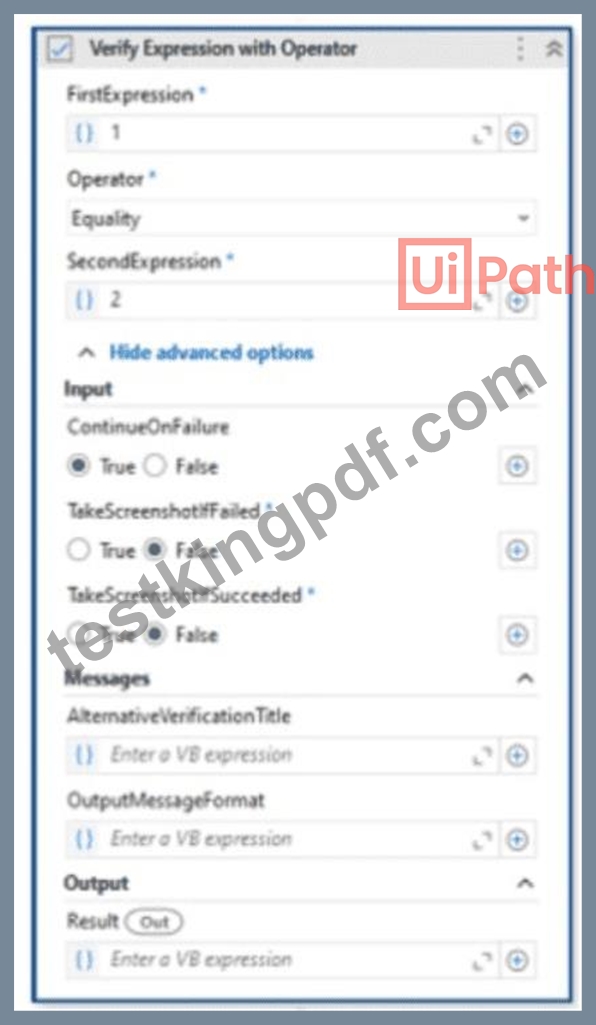
The activity is used within a Try-Catch activity. The Catch block is set to System.Exception and UiPath.
Testing.Exception.TestingActivitiesException as shown in the screenshot below:
During the execution of the sequence shown above, which block from the Try-Catch activity will be entered first, after the Verify Expression with Operator activity is executed?
- A. The Exception sequence from the Catches block within the Try-Catch activity.
- B. The Finally block within the Try-Catch activity.
- C. The TestingActivitiesException sequence from the Catches block within the Try-Catch activity.
- D. None of the other blocks within the Try-Catch activity will be executed.
Answer: A
Explanation:
The Verify Expression with Operator activity is used to verify an expression by asserting it in relation to a given expression with an operator1. The expressions tested with this activity must be inserted in their respective property fields. In this case, the activity is configured to verify if the expression "1" is equal to the expression "2". The result of this verification is stored in the Result property, which reflects the state of the verification activity1. If the verification fails, the activity throws a TestingActivitiesException, which is a custom exception type defined by the UiPath.Testing.Activities package2.
The Try-Catch activity is used to catch a specified exception type in a sequence or activity, and either displays an error notification or dismisses it and continues the execution3. The activity has three main sections: Try, Catches, and Finally. The Try section holds the activity or set of activities that could throw an exception. The Catches section indicates the exception type and holds the activity or set of activities to be performed when the specified exception is thrown. The Finally section holds the activity or set of activities to be performed after the Try and Catches blocks are executed, regardless of the result3.
In this scenario, the Verify Expression with Operator activity is placed in the Try section of the Try-Catch activity. The Catches section has two exceptions caught: System.Exception and TestingActivitiesException.
The Finally section is empty. During the execution of the sequence, the Verify Expression with Operator activity will throw a TestingActivitiesException, because the expressions 1 and 2 are not equal. The Try- Catch activity will catch this exception and enter the TestingActivitiesException sequence from the Catches section, where the appropriate actions can be performed to handle the error. Therefore, the correct answer is C:The Exception sequence from the Catches block within the Try-Catch activity will be entered first, after the Verify Expression with Operator activity is executed.
The other options are incorrect because:
* Option A is incorrect because the Try-Catch activity will execute one of the blocks within the Catches section, depending on the type of exception thrown by the Verify Expression with Operator activity. In this case, the TestingActivitiesException sequence will be executed.
* Option B is incorrect because the Finally block within the Try-Catch activity will be executed only after the Try and Catches blocks are executed, not before. The Finally block is used to perform any cleanup or final actions that are needed regardless of the outcome of the Try and Catches blocks3.
* Option D is incorrect because the TestingActivitiesException sequence from the Catches block within the Try-Catch activity will be entered second, not first, after the Verify Expression with Operator activity is executed. The first block to be entered is the Try block, where the Verify Expression with Operator activity is placed.
References:
Activities - Verify Expression With Operator - UiPath Documentation Portal UiPath.Testing.Activities Namespace Activities - Try Catch - UiPath Documentation Portal
NEW QUESTION # 48
In the Robotic Enterprise (RE) Framework, at which point should a developer log a clear message with the Logging Level set to "Information," adhering to the best practices for automating a production-level process?
- A. Whenever an argument or value is used.
- B. Whenever an exception is caught in a Catch block.
- C. Whenever data is fetched from external sources.
- D. Whenever the robot encounters an error on a Queue Item.
Answer: C
Explanation:
In the Robotic Enterprise Framework (REFramework), best practices for logging at the "Information" level suggest recording entries that are informative about the progress of the automation. This would typically include:
The start and end of a transaction.
Status updates of a transaction.
The result of an operation, like a successful data retrieval or submission.
From the provided options, the one that aligns best with this approach would be:
B: Whenever data is fetched from external sources.
This action is a significant step in most automation processes because it usually represents a point where the robot interacts with systems outside of its immediate control, and it's important to have a record that this step has been completed successfully. It provides a clear and traceable log entry that helps in understanding the workflow's progress and is useful for audit trails and troubleshooting.
Logging every time an argument or value is used (C) would be excessive and not practical for production-level processes. Logging every exception (A) and error on a Queue Item (D) would typically be done at a
"Warning" or "Error" level, not "Information".
NEW QUESTION # 49
Which one of the following expressions Is the equivalent of the If activity from the picture?
- A. message = lf(number mod 2 = 0. "Even number", "Odd number")
- B. message = lf(number mod 2 = 0 then "Odd number" else "Even number")
- C. message = lf(number mod 2 = 0. Odd number. Even number)
- D. message = lf(number mod 2 = 0 {"Odd number"} else {'Even number"})
Answer: A
Explanation:
This expression evaluates if the number modulo 2 equals 0, which would mean it is even. If true, it assigns the string "Even number" to the variable message. If false (meaning the number is odd), it assigns "Odd number" to message
NEW QUESTION # 50
......
Verified UiPath-ADPv1 dumps Q&As - Pass Guarantee Exam Dumps Test Engine: https://www.testkingpdf.com/UiPath-ADPv1-testking-pdf-torrent.html
UiPath-ADPv1 Dumps for Pass Guaranteed - Pass UiPath-ADPv1 Exam: https://drive.google.com/open?id=1wM1uVY0ZLgyPgPxfxmYAStkZJ--CWovV
