

PDF (New 2024) Actual UiPath UiPath-ADPv1 Exam Questions
Dumps Moneyack Guarantee - UiPath-ADPv1 Dumps UpTo 90% Off
NEW QUESTION # 50
Which Scraping method should be used for the Get Text activity to capture hidden text from an application?
- A. Default
- B. Full text
- C. Native
- D. Text attribute
Answer: B
Explanation:
The Get Text activity in UiPath Studio is used to extract and copy the text from a UI element. It has a property called Scraping method, which allows you to choose the method of scraping text from the target element. The available methods are Default, Text attribute, Full text, and Native.
The Default method tries all the other methods and chooses the best one automatically. The Text attribute method uses the text value of the target element as the output. The Native method uses the native method of the application to scrape the text, and allows formatting and screen coordinates to be retrieved. The Full text method uses an OCR engine to scrape the text, and offers the option to Ignore hidden text, which can be activated by selecting its respective check box.
To capture hidden text from an application, the Full text method with the Ignore hidden text option enabled should be used. This way, the Get Text activity can retrieve the text that is not visible on the screen, but is present in the UI element. For example, this method can be used to get the text from a combo box that has more items than the ones displayed, or from a terminal window that has more editable text than the ones shown.
References: Activities - Get Text - UiPath Documentation Portal, Get Text or Get Full Text for Hidden Text - Studio - UiPath Community Forum, How to: Scrape the Whole Text, Including Hidden Elements from ... - UiPath
NEW QUESTION # 51
What method can be used to change the index of an existing column in a datatable?
- A. SetColumnlndex
- B. SetOrdinal
- C. Move At
- D. Setlndex
Answer: B
NEW QUESTION # 52
A developer implemented a process using the Robotic Enterprise Framework and an Orchestrator queue. The MaxRetryNumber from the "Config.xlsx" file is set to "1" and the Max # of retries from the Queue settings from Orchestrator is set to "2". At runtime, the first transaction item throws a Business Exception.
How many times will the transaction be retried?
- A. The transaction will be retried multiple times, until it will be processed successfully.
- B. The transaction will not be retried.
- C. The transaction will be retried 2 times.
- D. The transaction will be retried only one time.
Answer: D
Explanation:
The transaction will be retried only one time because the MaxRetryNumber from the "Config.xlsx" file is set to "1". This parameter determines how many times a transaction item is retried when it fails with an application or a business exception. The Max # of retries from the Queue settings from Orchestrator is set to
"2", but this parameter only applies to the queue items that are marked as "Retry" by the robot. In the Robotic Enterprise Framework, the SetTransactionStatus workflow marks the queue items as "Retry" only if the MaxRetryNumber is not reached. Therefore, the first transaction item will be retried once by the robot and then marked as "Failed" in the queue, regardless of the Orchestrator setting.
NEW QUESTION # 53
Why is it necessary to add the UiPath virtual channel to the allow list policy for Citrix Virtual Apps and Desktops 7 2109?
- A. Because a secure connection should be created between the UiPath Remote Runtime and the Citrix receiver
- B. Because the UiPath Remote Runtime component should be enabled to access the Citrix workspace environment.
- C. Because custom virtual channels are blocked by default, preventing the UiPath Remote Runtime from functioning correctly
- D. Because the network latency should be decreased and the performance of UiPath automation processes on Citrix should be improved.
Answer: C
Explanation:
Custom virtual channels, by default, are blocked in Citrix Virtual Apps and Desktops, which would prevent the UiPath Remote Runtime from functioning correctly. Therefore, adding the UiPath virtual channel to the allow list policy is necessary for proper automation interaction.
NEW QUESTION # 54
What is the default OCR engine used in CV Screen Scope?
- A. UiPath Screen OCR
- B. Tesseract OCR
- C. Microsoft OCR
- D. Microsoft Azure Computer Vision OCR
Answer: A
Explanation:
The CV Screen Scope activity is used to initialize the UiPath Computer Vision neural network and provide a scope for all subsequent Computer Vision activities. It allows you to select which OCR engine you want to use for scraping the text in the target application. The default OCR engine used for this activity is UiPath Screen OCR, which is an in-house, machine-learning based OCR targeted for screens and digital text. It can be used as an alternative to the other OCR engines, such as Google OCR, Microsoft OCR, or Tesseract OCR. The engine can be changed by manually replacing the default engine with one of your choice1.
The other options are incorrect because:
Option B is incorrect because Microsoft OCR is not the default OCR engine used in CV Screen Scope. Microsoft OCR is an OCR engine that uses the MODI (Microsoft Office Document Imaging) Library to process images and extract text2.
Option C is incorrect because Tesseract OCR is not the default OCR engine used in CV Screen Scope. Tesseract OCR is an OCR engine that uses the open-source Tesseract library to process images and extract text3.
Option D is incorrect because Microsoft Azure Computer Vision OCR is not the default OCR engine used in CV Screen Scope. Microsoft Azure Computer Vision OCR is an OCR engine that uses the Microsoft Azure Computer Vision API to process images and extract text4.
References:
Activities - CV Screen Scope - UiPath Documentation Portal
Activities - Microsoft OCR - UiPath Documentation Portal
Activities - Tesseract OCR - UiPath Documentation Portal
Activities - Microsoft Azure Computer Vision OCR - UiPath Documentation Portal
NEW QUESTION # 55
What is a pre-requisite for running functional test cases in REFramework?
- A. Invoke InitAIISettings XAML file
- B. Invoke SetTransactionStatus XAML file
- C. Invoke Main XAML file
- D. Invoke Process XAML file
Answer: A
NEW QUESTION # 56
What is the purpose of The Relative To feature in Computer Vision activities?
- A. To compare the size and position of Ul elements in different applications.
- B. To synchronize the timing of multiple Computer Vision activities in the same project.
- C. To create a fixed relationship between Computer Vision actions and Ul element positions.
- D. To configure the target as being relative to an element, either a single point or an area selection in the application.
Answer: D
Explanation:
The Relative To feature in Computer Vision activities is used to configure the target as being relative to an element, either a single point or an area selection in the application. This feature enhances the accuracy and reliability of UI automation.
NEW QUESTION # 57
Assume we have the Verify Expression with Operator activity from the UiPath. Testing.Activities package with the properties configured as follows:
The activity is used within a Try-Catch activity. The Catch block is set to System.Exception and UiPath.Testing.Exception.TestingActivitiesException as shown in the screenshot below:
During the execution of the sequence shown above, which block from the Try-Catch activity will be entered first, after the Verify Expression with Operator activity is executed?
- A. The TestingActivitiesException sequence from the Catches block within the Try-Catch activity.
- B. The Exception sequence from the Catches block within the Try-Catch activity.
- C. The Finally block within the Try-Catch activity.
- D. None of the other blocks within the Try-Catch activity will be executed.
Answer: B
Explanation:
The Verify Expression with Operator activity is used to verify an expression by asserting it in relation to a given expression with an operator1. The expressions tested with this activity must be inserted in their respective property fields. In this case, the activity is configured to verify if the expression "1" is equal to the expression "2". The result of this verification is stored in the Result property, which reflects the state of the verification activity1. If the verification fails, the activity throws a TestingActivitiesException, which is a custom exception type defined by the UiPath.Testing.Activities package2.
The Try-Catch activity is used to catch a specified exception type in a sequence or activity, and either displays an error notification or dismisses it and continues the execution3. The activity has three main sections: Try, Catches, and Finally. The Try section holds the activity or set of activities that could throw an exception. The Catches section indicates the exception type and holds the activity or set of activities to be performed when the specified exception is thrown. The Finally section holds the activity or set of activities to be performed after the Try and Catches blocks are executed, regardless of the result3.
In this scenario, the Verify Expression with Operator activity is placed in the Try section of the Try-Catch activity. The Catches section has two exceptions caught: System.Exception and TestingActivitiesException.
The Finally section is empty. During the execution of the sequence, the Verify Expression with Operator activity will throw a TestingActivitiesException, because the expressions 1 and 2 are not equal. The Try-Catch activity will catch this exception and enter the TestingActivitiesException sequence from the Catches section, where the appropriate actions can be performed to handle the error. Therefore, the correct answer is C. The Exception sequence from the Catches block within the Try-Catch activity will be entered first, after the Verify Expression with Operator activity is executed.
The other options are incorrect because:
Option A is incorrect because the Try-Catch activity will execute one of the blocks within the Catches section, depending on the type of exception thrown by the Verify Expression with Operator activity. In this case, the TestingActivitiesException sequence will be executed.
Option B is incorrect because the Finally block within the Try-Catch activity will be executed only after the Try and Catches blocks are executed, not before. The Finally block is used to perform any cleanup or final actions that are needed regardless of the outcome of the Try and Catches blocks3.
Option D is incorrect because the TestingActivitiesException sequence from the Catches block within the Try-Catch activity will be entered second, not first, after the Verify Expression with Operator activity is executed. The first block to be entered is the Try block, where the Verify Expression with Operator activity is placed.
References:
Activities - Verify Expression With Operator - UiPath Documentation Portal UiPath.Testing.Activities Namespace Activities - Try Catch - UiPath Documentation Portal
NEW QUESTION # 58
Following UiPath best practices, which project structure is best-suited for complex processes in UiPath Studio?
- A. State Machine
- B. Flowchart
- C. Sequence
- D. Global Exception Handler
Answer: A
NEW QUESTION # 59
Based on the following exhibit, which output is displayed in the Output panel rt Step Out is clicked on the Debug ribbon tab of UlPath Studio?
- A. UiPath RPAAutomatlon
- B. Automation RPAUiPath RPA
- C. UiPath RPA
- D. Automation
Answer: A
NEW QUESTION # 60
What are the two types of elements that can Be included in an Object Repository?
- A. Ul elements and non-UI elements.
- B. Dynamic elements and static elements
- C. Web elements and mobile elements.
- D. Local elements and library elements.
Answer: D
Explanation:
In the Object Repository in UiPath, there are two types of elements: Local elements and library elements.
Local elements are specific to a project, while library elements can be reused across multiple projects.
NEW QUESTION # 61
A project built using REFramework pulls phone numbers from a database of employees and creates queue items for each one. Following processing, these elements must be added to a financing application. The queue item holding a phone number becomes invalid if a digit is accidentally left out because of a human mistake. As a requirement, queue items that contain partial numbers should not be accepted.
What type of error should be thrown according to best practices?
- A. System Exception
- B. Application Exception
- C. Business Exception
- D. Fatal Exception
Answer: C
NEW QUESTION # 62
Considering that the attached table is stored in a variable called "dt":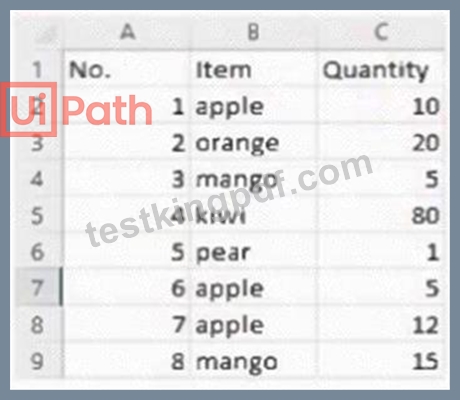
Which LINQ query can be used to return the maximum total Quantity?
- A. dt.AsEnumerable. Max(Function(x) Convert.ToInt32(x("Quantity").ToString))("Item")
- B. dt.AsEnumerable. Max(Function(x) Convert.ToInt32(x("Quantity").ToString))
- C. dt.AsEnumerable. GroupBy(Function(x) x("Item").ToString). Max(Function(x) x.Sum(Function(y) Convert.ToInt32(y("Quantity").ToString)))
- D. dt.AsEnumerable. OrderByDescending(Function(x) Convert.ToInt32(x("Quantity").ToString)).First.Item("Quantity")
Answer: C
Explanation:
The LINQ query that can be used to return the maximum total Quantity from the attached table is dt.AsEnumerable. GroupBy(Function(x) x("Item").ToString). Max(Function(x) x.Sum(Function(y) Convert.ToInt32(y("Quantity").ToString))). This query uses the LINQ methods AsEnumerable, GroupBy, Max, and Sum to manipulate the data in the dt variable. The dt variable is a DataTable that contains the following data:
No.
Item
Quantity
1
apple
10
2
orange
20
3
mango
50
4
kiwi
80
5
pear
1
6
apple
5
7
mango
15
The AsEnumerable method converts the DataTable into an Enumerable collection of DataRow objects. The GroupBy method groups the elements of the collection by the value of the Item column, creating a collection of groups. Each group has a key, which is the Item name, and a list of elements, which are the DataRows that have the same Item value. The Max method returns the maximum value of the collection, based on a selector function. The selector function is a lambda expression that calculates the sum of the Quantity column for each group. The Sum method returns the sum of the elements in a collection, based on a selector function. The selector function is a lambda expression that converts the value of the Quantity column into an integer.
Therefore, the query will group the DataRows by the Item name, calculate the total Quantity for each group, and return the maximum total Quantity among the groups. The maximum total Quantity is 80, which corresponds to the group with the key "kiwi". References: [DataTable.AsEnumerable Method],
[Enumerable.GroupBy Method], [Enumerable.Max Method], [Enumerable.Sum Method]
NEW QUESTION # 63
What is the purpose of the Interval filter in the Orchestrator's Monitoring page?
- A. It enables you to sort the displayed data based on job priorities.
- B. It allows you to allocate licenses per machine for the displayed data.
- C. It allows you to control the granularity of the displayed data and check the health of your system in either the last day or the last hour.
- D. It allows you to choose between background and foreground processes for the displayed data.
Answer: C
NEW QUESTION # 64
Which of the following statements is true about the existing UiPath Studio installation packages?
- A. The Automation Developer installation package installs only UiPath Studio, Assistant, and Robot.
- B. The Unattended Robot installation package installs only UiPath Studio, Assistant, and Robot.
- C. The Attended Robot installation package installs only UiPath Studio, and Robot.
- D. The Attended Robot installation package installs only the UiPath Robot.
Answer: D
Explanation:
The statement that is true about the existing UiPath Studio installation packages is that the Attended Robot installation package installs only the UiPath Robot. The UiPath Robot is the component that executes the automation workflows designed in UiPath Studio. The Attended Robot installation package is intended for scenarios where the Robot works on the same machine as a human user and requires human input or supervision. The Attended Robot installation package does not include UiPath Studio or UiPath Assistant.
UiPath Studio is the component that allows the developer to design and debug the automation workflows.
UiPath Assistant is the component that allows the user to manage and run the automation workflows on their machine. The Unattended Robot installation package and the Automation Developer installation package both include UiPath Studio, UiPath Assistant, and UiPath Robot, but they are intended for different scenarios. The Unattended Robot installation package is for scenarios where the Robot works on a dedicated machine and does not require human input or supervision. The Automation Developer installation package is for scenarios where the developer needs to create and test the automation workflows on their machine. References: [UiPath Installation Guide], [UiPath Robot], [UiPath Studio], [UiPath Assistant]
NEW QUESTION # 65
A developer is working on an automation using the REFramework. Each transaction item represents a piece of client information. For each customer, the automated procedure must click the "Generate Shipment Details" button. This generates a table of shipment records for each customer.
What type of exception occurs when the data is not accessible, the created table displays only the header row, and processing for that client must be halted?
- A. NullReferenceException
- B. SystemException
- C. ApplicationException
- D. BusinessRuleException
Answer: D
NEW QUESTION # 66
......
Updated Mar-2024 Pass UiPath-ADPv1 Exam - Real Practice Test Questions: https://www.testkingpdf.com/UiPath-ADPv1-testking-pdf-torrent.html
Pass Your Exam With 100% Verified UiPath-ADPv1 Exam Questions: https://drive.google.com/open?id=14Avr9wRNULadRZVPwPfnELfr8fUpeylm
