

Maximum Grades By Making ready With OG0-093 Dumps UPDATED 2025
Prepare OG0-093 Exam Questions [2025] Recently Updated Questions
NEW QUESTION # 232
Consider the following ADM phases objectives.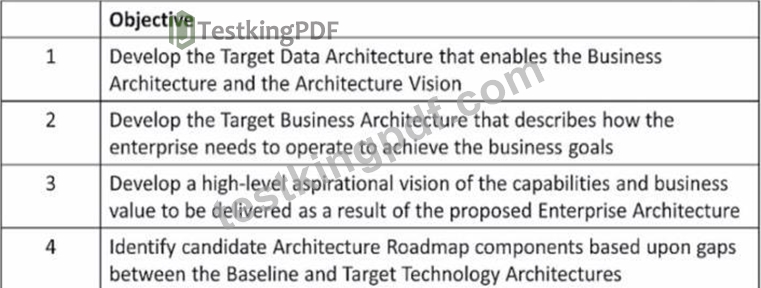
Which phase does each objective match?
- A. 1C-2B-3A-4D
- B. 1C-2D-3B-4A
- C. 1B-2D-3A-4C
- D. 1A-2B-3C-4D
Answer: A
NEW QUESTION # 233
According to TOGAF, which of the following best describes the purpose of an Architecture Definition Document?
- A. To govern the architecture throughout its implementation process
- B. To act as a deliverable container for artifacts created during a project
- C. To ensure that architecture information is communicated to the right stakeholders at the right time
- D. To show progression of change from the Baseline Architecture to the Target Architecture
- E. To provide a high-level view of the end architecture product
Answer: B
NEW QUESTION # 234
Scenario
Please read this scenario prior to answering the Question
You are serving as the Lead Architect for an enterprise architecture project team within a leading
multinational pharmaceutical and medical devices manufacturer. Its brands include numerous household
names for medications and first aid supplies.
The company has a long history of innovating new treatments for many common illnesses and diseases.
Prior to launching a new treatment, the company has to demonstrate Its effectiveness and safety in a set
of clinical trials that satisfy the regulatory requirements of the countries in the target markets. All clinical
trials are undertaken by its research laboratories, which employ over 10,000 people at separate facilities in
the United Kingdom, United States, Sweden, France, Canada, India, China and Japan. In addition to
internal research and development activities the company is also involved in publicly funded collaborative
research projects, with other industrial and academic partners.
The Enterprise Architecture group within the company has been engaged in an architecture development
project to create a secure networked collaboration system that will allow researchers at its product
development laboratories worldwide to share information about their clinical trials. This system will also
connect with external partners.
The Enterprise Architecture group within the company has been engaged in an architecture development
project to create a secure networked collaboration system that will allow researchers at its product
development laboratories worldwide to share information about their clinical trials. This system will also
connect with external partners.
The Enterprise Architecture group is a mature organization. They use the TOGAF 9 ADM with extensions
required to support current good manufacturing practices and good laboratory practices in their target
markets. Due to the highly sensitive nature of the information that is managed, special care was taken to
ensure that each architecture domain included an examination of the security and privacy issues that are
relevant.
The Executive Vice President for Clinical Research is the sponsor of the Enterprise Architecture activity.
She has stated that the changes to the enterprise architecture for the new system will need to be rolled out
in stages on a regional basis that minimizes disruptions to ongoing clinical trials.
Refer to the Scenario
You have been asked to recommend the approach to identify the work packages that will be included in
the Transition Architecture(s).
Based on TOGAF, which of the following is the best answer?
- A. Use a Consolidated Gaps, Solutions and Dependencies Matrix as a planning tool. For each gap
classify whether the solution is either a new development, purchased solution, or based on an existing
product. Group the similar solutions together to define the work packages. Regroup the work packages
into a set of Capability Increments to transition to the Target Architecture taking into account the
schedule for clinical trials. - B. Determine the set of Solution Building Blocks required by identifying which Solution Building Blocks
need to be developed and which need to be procured. Eliminate any duplicate building blocks. Group
the remaining Solution Building Blocks together to create the work packages using a CRUD matrix.
Rank the work packages in terms of cost and select the most cost-effective options for inclusion in a
series of Transition Architectures. Schedule the roll out of the work packages to be sequential across
the geographic regions. - C. Create an Implementation Factor Assessment and Deduction Matrix and a Consolidated Gaps,
Solutions and Dependencies Matrix. For each gap, identify a proposed solution and classify it as new
development, purchased solution, or based on an existing product. Group similar solutions together to
form work packages. Identify dependencies between work packages factoring in the clinical trial
schedules. Regroup the packages into a set of Capability Increments scheduled into a series of
Transition Architectures. - D. Group the Solution Building Blocks from a Consolidated Gaps, Solutions and Dependencies Matrix into
a set of work packages. Using the matrix as a planning tool, regroup the work packages to account for
dependencies. Sequence the work packages into the Capability Increments needed to achieve the
Target Architecture. Schedule the rollout one region at a time. Document the progression of the
enterprise architecture using a state evolution table.
Answer: A
NEW QUESTION # 235
Which of the following does the TOGAF ADM recommend for use in developing an Architecture Vision document?
- A. Gap Analysis
- B. Requirement Management
- C. Business Scenarios
- D. Architecture Principles
- E. Interoperability Analysis
Answer: D
Explanation:
Section: Part 2
NEW QUESTION # 236
Scenario:
Please read this scenario prior to answering the question
The ABC company is a major supplier in the automotive industry, headquartered in Cleveland, Ohio with manufacturing plants in Chicago, Sao Paulo, Stuttgart, Yokohama, and Seoul. Each of these plants has been operating its own planning and production scheduling systems, as well as custom developed applications that drive the automated production equipment at each plant.
The company is implementing lean manufacturing principles to minimize waste and improve the efficiency of all of its production operations. During a recent exercise held for internal quality improvement, it was determined that a significant reduction in process waste could be achieved by replacing the current planning and scheduling systems with a common Enterprise Resource Planning (ERP) system located in the Cleveland data center. This central system would provide support to each of the plants replacing the functionality in the existing systems. It would also eliminate the need for full data centers at each of the plant facilities. A reduced number of IT staff could support the remaining applications. In some cases, a third-party contractor could provide those staff.
The company Enterprise Architecture department has been operating for several years and has mature, well-developed architecture governance and development processes that are strongly based on TOGAF 9. At a recent meeting, the Architecture Review Board approved a Request for Architecture Work from the Chief Engineer of Global Manufacturing Operations who is the project sponsor. The request covered the initial architectural investigations and the development of a comprehensive architecture to plan the transformation.
The Common ERP Deployment architecture project team has now been formed, and the project team has been asked to develop an Architecture Vision that will achieve the desired outcomes and benefits. Some of the plant managers have expressed concern about the security and reliability of driving their planning and production scheduling from a central system located in Cleveland. The Chief Engineer wants to know how these concerns can be addressed.
Refer to the Scenario
You are serving as the Lead Enterprise Architect of the newly-formed Common ERP Deployment architecture project team.
As the Common ERP Deployment architecture project team assembles for its initial meeting, many of the participants have voiced concerns about the sweeping scope of the initiative. Others are confident that they know a solution that will work. During the meeting, a number of alternative recommendations for how to proceed are put forward by members of the team.
You have been asked to select the most appropriate recommendation to ensure that the team evaluates different approaches to the problem and clarifies the requirements for the architecture.
Based on TOGAF 9, which of the following is the best answer?
- A. The team should create Baseline and Target Architectures for each of the manufacturing plants. A gap analysis between the architectures will then validate the approach, and determine the Transition Architecture needed to achieve the target state.
- B. The team should exercise due diligence and carefully research vendor literature and conduct a series of briefings with vendors that are on the current approved supplier list. Based on the findings from the research, the team should define a preliminary target Architecture Vision. The team should then use that model to build consensus among the key stakeholders.
- C. The team should conduct a pilot project that will enable vendors on the short list to demonstrate potential solutions that will address the concerns of the stakeholders. Based on the findings of that pilot project, a complete set of requirements can be developed that will drive the evolution of the architecture.
- D. The team should hold a series of interviews at each of the manufacturing plants using the business scenario technique. This will then enable them to identify and document the characteristics of the architecture from the business requirements.
Answer: A
NEW QUESTION # 237
Complete the sentence. The TOGAF Architecture Governance Framework includes ________________.
- A. a list of responsibilities for running an Architecture Board
- B. guidance for establishing an Architecture Capability using the ADM
- C. the Architecture Compliance review process and checklists
- D. a model for governance including process, content and context
Answer: D
Explanation:
Section: Part 1
NEW QUESTION # 238
What level of risk is the risk categorization prior to determining and implementing mitigating actions?
- A. Critical
- B. Marginal
- C. Initial
- D. Low
- E. Residual
Answer: C
Explanation:
Section: Part 1
Explanation/Reference: https://pubs.opengroup.org/architecture/togaf9-doc/arch/chap27.html
NEW QUESTION # 239
Which of the following statements about TOGAF Building Blocks and their use in the ADM cycle is correct?
- A. Building Blocks should be first selected in Phase D
- B. Building Blocks should be identified in abstract form as part of the Preliminary Phase
- C. Building Blocks become more implementation-specific in Phase E
- D. Building Blocks in phases D, E and F are evolved to a common pattern of steps
Answer: C
NEW QUESTION # 240
According to TOGAF, which of the following best describes the classification of architectural change in the case where multiple server systems are being consolidated to a single system?
- A. A re-architecting change that puts the whole architecture through an ADM cycle
- B. A revision change of the enterprise architecture
- C. A bottom-up change to enhance operational capability
- D. A simplification change handled via change management techniques
- E. An incremental change handled via change management techniques
Answer: D
NEW QUESTION # 241
Which of the following best describes the Standards Information Base?
- A. A repository area that defines the parameters, structures, and processes to support governance.
- B. A repository area that lists a set of specifications to which architectures must conform
- C. A repository area that provides a record of the governance activity across the enterprise.
- D. A repository area that provides guidelines, templates, and pattern used to create new architectures.
- E. A repository area that describes the organization specific architecture framework and methodologies.
Answer: B
Explanation:
Explanation
Reference https://pubs.opengroup.org/architecture/togaf91-doc/arch/chap41.html
NEW QUESTION # 242
Complete the sentence. The TOGAF standard covers the development of four architecture domains.
Application, Data, _________________.
- A. Business and Technology
- B. Baseline and Transition
- C. Vision and Requirements
- D. Capability and Segment
- E. Information and Knowledge
Answer: A
Explanation:
Explanation
Reference https://pubs.opengroup.org/architecture/togaf9-doc/arch/chap06.html
NEW QUESTION # 243
Which of the following is described by the TOGAF document as "a detailed plan of the system at component level to guide its implementation"?
- A. Architecture
- B. Deliverable
- C. View
- D. Artifact
- E. Model
Answer: A
NEW QUESTION # 244
Scenario:
Please read this scenario prior to answering the question
Your role is consultant to the Lead Architect within a company that manufactures a variety of small electromechanical devices. As part of a corporate-wide Lean Manufacturing initiative, the company has defined a strategic architecture to improve its ability to meet consumer demand and improve its ability to manage its supply chain. The strategic architecture called for the consolidation of multiple Enterprise Resource Planning (ERP) applications that have been operating independently in several of the divisions' production facilities. The goal is to replace the functionality of the existing applications with a new ERP product running as a single instance in the company's primary data center.
The company has a mature enterprise architecture practice and uses TOGAF 9 for the basis of its architecture framework. In addition to the EA program, the company has a number of management frameworks in use, including business planning, portfolio/project management, and operations management. The EA program is sponsored by the CIO.
Each division has completed the Architecture Definition documentation required to tailor and configure the environment to meet its own specific manufacturing requirements.
The enterprise architects have analyzed the key corporate change attributes and implementation constraints. A consolidated gap analysis has been completed which has identified the gaps across the Business, Data, Application, and Technology domains. Based on the results of the gap analysis, the architects have reviewed the requirements, dependencies and interoperability requirements needed to integrate the new ERP environment into the existing environment. The architects have completed the Business Transformation Readiness Assessment started in Phase A. Based on all of these factors they have produced a risk assessment.
Because of the risks posed by the complexity of the current environment, it has been determined that a phased approach is needed to implement the target architectures. The overall implementation process is estimated to take several years.
Refer to the Scenario
The Implementation and Migration Plan v0.l, the draft Architecture Roadmap, and the Capability Assessment deliverables are now complete. You have been asked to recommend the next steps to prepare the final Implementation and Migration Plan.
Based on TOGAF 9, which of the following is the best answer?
- A. You would place the strategic Architecture Definition and Transition Architectures under configuration control as part of the ongoing architecture development cycle. This will ensure that the architecture remains relevant and responsive to the needs of the enterprise. You would then produce an Implementation Governance Model to manage the lessons learned prior to finalizing the plan. You recommend that lessons learned be accepted by the Architecture Board as changes to the architecture without review.
- B. You would conduct a series of Compliance Assessments to ensure that the implementation team is implementing the architecture according to the contract. The Compliance Assessment should verify that the implementation team is using the proper development methodology. It should include deployment of monitoring tools and ensure that performance targets are being met. If they are not met, then changes to performance requirements should be identified and updated in the Implementation and Migration Plan.
- C. You would assess how the plan impacts the other frameworks in use in the organization. Minimally, the plan should be coordinated with the business planning, portfolio/project management and operations management frameworks. You would then assign a business value to each project, taking into account available resources and priorities for the projects. Finally, you would generate the Implementation and Migration Plan.
- D. You would apply the Business Value Assessment Technique to prioritize the implementation projects and project increments. The assessment should focus on return on investment and performance evaluation criteria that can be used to monitor the progress of the architecture transformation. You would confirm the Transition Architecture phases using an Architecture Definition Increments Table to list the projects. You would then document the lessons learned and generate the final plan.
Answer: D
Explanation:
Business Value Technique usually follows BTRA, and will fulfil the requirement to phase approach by prioritizing projects and listing their execution using ADI table.
NEW QUESTION # 245
Which one of the following best describes an Architecture Compliance Review?
- A. A review of the baseline and target architectures to identify gaps
- B. A review of an architecture project against established criteria and business objectives
- C. A review of the organization's ability to share information and services
- D. A review of the readiness and ability of an organization to accept change
- E. A review of the plans for enterprise transformation
Answer: B
Explanation:
Section: Part 1
NEW QUESTION # 246
In which of the following ADM Phases do building blocks become implementation-specific?
- A. Phase A
- B. Phase C
- C. Phase E
- D. Phase B
- E. Phase D
Answer: C
Explanation:
Section: Part 1
NEW QUESTION # 247
Which of the following best describes the TOGAF Architecture Governance Framework?
- A. A model intended to assist with the release management of the TOGAF specification itself
- B. An example set of Architecture Principles
- C. An architecture of building blocks and corresponding standards, together with associated graphics
- D. An approach to ensure the effectiveness of an organization's architectures
- E. A reference model that includes information provider applications and brokering applications
Answer: D
NEW QUESTION # 248
Why does the TOGAF standard recommend that the Business Architecture be developed first?
- A. It includes preparation activities such as customization of the method
- B. It is the key document describing how the new architecture capability will meet the business goals
- C. It provides prerequisite knowledge for undertaking architecture work in the other domains
- D. It mobilizes operations to support the ongoing business architecture development
- E. It contains a high level description of the business strategy for the organization
Answer: C
Explanation:
Reference
http://pubs.opengroup.org/architecture/togaf8-doc/arch/chap06.html
NEW QUESTION # 249
Scenario:
Please read this scenario prior to answering the Question
You have been assigned the role of Lead Enterprise Architect for a manufacturing firm that specializes in musical instruments. The firm has been established for over 100 years, operating in North America for most of that time. In the last ten years, the firm has expanded into European markets and will soon establish a market in Latin America. A future expansion into the Asia Pacific region is also planned.
The firm is organized into several business units that each focus on manufacturing particular families of instruments such as brass, woodwind, and percussion. Each business unit has acquired other producers to expand its manufacturing capacity. This has resulted in a complex environment with a high diversity of business and manufacturing systems.
The Enterprise Architecture (EA) program within the firm has been functioning for several years. It has made significant progress in consolidating the technology portfolio and establishing key standards. The CIO and the COO are pint sponsors of the EA program. The EA program is mature, with an active Architecture Board and a well-defined architecture process and standard content templates based on the TOGAF 9 Architecture Content Framework. The EA process framework is well coordinated with the PMO, Systems Development, and Operations functions.
The firm has completed a strategic plan to reorganize its Sales & Marketing organization according to the four target geographic markets. One of the goals of this reorganization is to improve the ability of Marketing to collect more meaningful market analytics that will enable each sector to better address market needs with effective marketing campaigns and global product presence.
A Request for Architecture Work to address the goals of the reorganization has been approved. As the architecture team commences its work, the CIO has expressed concerns about whether the firm will be able to adapt to the proposed architecture and how to manage the associated risks.
Refer to the Scenario
You have been asked how to address the concerns of the CIO.
Based on TOGAF 9, which of the following is the best answer?
- A. In Phase A, the team should conduct a Business Scenario to identify the stakeholders' concerns and the resulting retirements. Once the retirements have been identified, they can be assessed in terms of their risks. The risks should be evaluated in terms of how they could be avoided, transferred, or mitigated.
Any risks that cannot be resolved should be identified as residual risks and their disposition should be decided by the Architecture Board. - B. In Phase B, the team should create a set of views that will enable them to identify the factors that will influence the successful introduction of the architecture into the organization. There should then be an assessment of each factor on a maturity scale that will allow the team to gauge the urgency, readiness, and degree of difficulty to fix. These factors can then be used to assess the initial risks associated with the proposed architecture.
- C. In Phase A, the team should use the Business Transformation Readiness Assessment technique to identify the factors that will influence the successful introduction of the architecture into the organization. The assessment should include determining the readiness rating for each factor based on a maturity scale that will allow the team to gauge the urgency, readiness, and degree of difficulty to fix.
These factors can then be used to assess the initial risks associated with the proposed architecture. - D. In Phase A, the team should analyze their risk by completing an Implementation Factor Assessment and Deduction Matrix to identify the particular risks associated with the implementation and deployment.
The matrix should include a list of factors to be considered, their descriptions, and constraints that should be taken into account. These factors can then be used to assess the initial risks associated with the proposed architecture.
Answer: C
Explanation:
Explanation
This scenario is upon Request for Architecture Work, which kicks off the Phase A, the Architecture Vision. In this phase, risk should be considered, which is also the CIO's concern in this scenario. One of the approaches in TOGAF is the Business Transformation Readiness Assessment.
Incorrect:
Not B: Implementation Factor Assessment and Deduction Matrix is used for implementation & migration planning (not B).
NEW QUESTION # 250
Which of the following best describes the Standards Information Base?
- A. A repository area holding specifications to which architectures must conform
- B. A repository area holding a record of the governance activity across the enterprise
- C. A repository area holding guidelines and templates used to create new architectures
- D. A repository area holding a description of the organization specific architecture framework and method
- E. A repository area holding processes to support governance of the Architecture Repository
Answer: A
NEW QUESTION # 251
Which one of the following best describes an Architecture Compliance Review?
- A. A review of the baseline and target architectures to identify gaps
- B. A review of an architecture project against established criteria and business objectives
- C. A review of the organization's ability to share information and services
- D. A review of the readiness and ability of an organization to accept change
- E. A review of the plans for enterprise transformation
Answer: B
NEW QUESTION # 252
What technique does TOGAF recommend for evaluating the status of an organization to undergo
change?
- A. Business Transformation Readiness Assessment
- B. Capability-Based Planning
- C. Communications and Stakeholder Management
- D. Gap Analysis
- E. Business Value Assessment Technique
Answer: A
NEW QUESTION # 253
Complete the sentence. The Architecture Landscape is divided into three levels, Capability, Segment, and ____________.
- A. Target
- B. Baseline
- C. Strategic
- D. Solution
- E. Transition
Answer: C
NEW QUESTION # 254
Which section of the TOGAF document describes the processes, skills and roles to establish and operate
an architecture function within an enterprise?
- A. Part III: ADM Guidelines and Techniques
- B. Part VII: Architecture Capability Framework
- C. Part VI: TOGAF Reference Models
- D. Part IV: Architecture Content Framework
- E. Part II: Architecture Development Method
Answer: B
NEW QUESTION # 255
......
Give push to your success with OG0-093 exam questions: https://www.testkingpdf.com/OG0-093-testking-pdf-torrent.html
OG0-093 100% Guarantee Download OG0-093 Exam PDF Q&A: https://drive.google.com/open?id=1E9VZ1McmeGfyxoTzwbLfTy9flHpLNe8d
