

Free CompTIA CASP CAS-004 Ultimate Study Guide (Updated 620 Questions)
Get to the Top with CAS-004 Practice Exam Questions
NEW QUESTION # 85
During a recent security incident investigation, a security analyst mistakenly turned off the infected machine prior to consulting with a forensic analyst. upon rebooting the machine, a malicious script that was running as a background process was no longer present. As a result, potentially useful evidence was lost. Which of the following should the security analyst have followed?
- A. Verification
- B. Chain of custody
- C. Order of volatility
- D. Secure storage
Answer: C
Explanation:
Order of volatility is a procedure that a computer forensics examiner must follow during evidence collection. It refers to the order in which digital evidence is collected, starting with the most volatile and moving to the least volatile. Volatile data is data that is not permanent and is easily lost, such as data in memory when you turn off a computer. The security analyst should have followed the order of volatility to preserve the most fragile evidence first, such as the malicious script running as a background process, before turning off the infected machine. Verified Reference:
https://www.computer-forensics-recruiter.com/order-of-volatility/
https://www.sans.org/blog/best-practices-in-digital-evidence-collection/
https://blogs.getcertifiedgetahead.com/order-of-volatility/
NEW QUESTION # 86
A network administrator receives a ticket regarding an error from a remote worker who is trying to reboot a laptop. The laptop has not yet loaded the operating system, and the user is unable to continue the boot process. The administrator is able to provide the user with a recovery PIN, and the user is able to reboot the system and access the device as needed. Which of the following is the MOST likely cause of the error?
- A. Lockout of privileged access account
- B. Failure of the Kerberos time drift sync
- C. Failure of TPM authentication
- D. Duration of the BitLocker lockout period
Answer: C
Explanation:
The most likely cause of the error is the failure of TPM authentication. TPM stands for Trusted Platform Module, which is a hardware component that stores encryption keys and other security information. TPM can be used by BitLocker to protect the encryption keys and verify the integrity of the boot process. If TPM fails to authenticate the laptop, BitLocker will enter recovery mode and ask for a recovery PIN, which is a 48-digit numerical password that can be used to unlock the system. The administrator should check the TPM status and configuration and make sure it is working properly.
NEW QUESTION # 87
A pharmaceutical company uses a cloud provider to host thousands of independent resources in object storage. The company needs a practical and effective means of discovering data, monitoring changes, and identifying suspicious activity. Which of the following would best meet these requirements?
- A. A cloud configuration assessment and compliance service
- B. An automated data classification system
- C. A machine-learning-based data security service
- D. A file integrity monitoring service
Answer: C
Explanation:
A machine-learning-based data security service provides dynamic discovery, anomaly detection, and behavioral analysis. It effectively identifies changes and suspicious activity across large-scale environments, such as object storage in the cloud. This aligns with CASP+ objective 4.3, emphasizing the use of advanced analytics and ML to improve data security.
NEW QUESTION # 88
A security analyst is designing a touch screen device so users can gain entry into a locked room by touching buttons numbered zero through nine in a specific numerical sequence. The analyst designs the keypad so that the numbers are randomly presented to the user each time the device is used. Which of the following best describes the design trade-offs? (Select two.)
- A. End users will have a more difficult time remembering the access numbers.
- B. This design makes entering numbers more difficult for users.
- C. Weak or easily guessed access numbers are more likely.
- D. The routines to generate the random sequences are trivial to implement.
- E. The risk of someone overseeing a pattern as a user enters the numbers is decreased.
- F. The device needs to have additional power to compute the numbers.
Answer: B,E
Explanation:
Step by Step
A: Randomizing the keypad reduces the risk of shoulder-surfing attacks by eliminating predictable patterns.
C: Randomization increases the cognitive load on users, making it harder to input numbers quickly.
D: Additional computational power is minimal and not typically a trade-off.
E and F: Remembering access numbers or weak passwords are unrelated to keypad randomization.
NEW QUESTION # 89
A security researcher identified the following messages while testing a web application: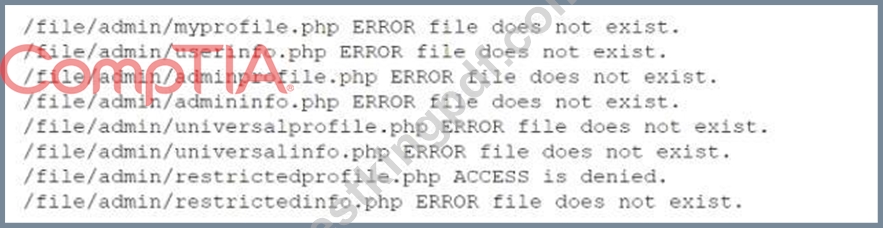
Which of the following should the researcher recommend to remediate the issue?
- A. Software composition analysis
- B. Elimination of the use of unsafe functions
- C. Packet inspection
- D. Proper error handling
Answer: D
Explanation:
The log messages in the image display detailed error messages, indicating improper error handling, which can expose sensitive information to potential attackers. Proper error handling ensures that error messages do not reveal underlying application details (such as file paths or configuration information) that could be exploited.
This aligns with the best practices in secure coding and is a core concept in CASP+. Rather than exposing the inner workings of the application, the system should return generic error messages to users while logging detailed information securely for internal troubleshooting.
References:
CASP+ CAS-004 Exam Objectives: Domain 2.0 - Enterprise Security Operations (Secure Coding, Error Handling) CompTIA CASP+ Study Guide: Web Application Security and Proper Error Handling Techniques
NEW QUESTION # 90
An organization's finance system was recently attacked. A forensic analyst is reviewing the contents Of the compromised files for credit card dat a.
Which of the following commands should the analyst run to BEST determine whether financial data was lost?
- A. Option B
- B. Option C
- C. Option A
- D. Option D
Answer: B
NEW QUESTION # 91
A security architect is designing a solution for a new customer who requires significant security capabilities in its environment. The customer has provided the architect with the following set of requirements:
* Capable of early detection of advanced persistent threats.
* Must be transparent to users and cause no performance degradation.
+ Allow integration with production and development networks seamlessly.
+ Enable the security team to hunt and investigate live exploitation techniques.
Which of the following technologies BEST meets the customer's requirements for security capabilities?
- A. Centralized logging
- B. Threat Intelligence
- C. Sandbox detonation
- D. Deception software
Answer: D
Explanation:
Deception software is a technology that creates realistic but fake assets (such as servers, applications, data, etc.) that mimic the real environment and lure attackers into interacting with them. By doing so, deception software can help detect advancedpersistent threats (APTs) that may otherwise evade traditional security tools
12. Deception software can also provide valuable insights into the attacker's tactics, techniques, and procedures (TTPs) by capturing their actions and behaviors on the decoys13.
Deception software can meet the customer's requirements for security capabilities because:
* It is capable of early detection of APTs by creating attractive targets for them and alerting security teams when they are engaged12.
* It is transparent to users and causes no performance degradation because it does not interfere with legitimate traffic or resources13.
* It allows integration with production and development networks seamlessly because it can create decoys that match the network topology and configuration13.
* It enables the security team to hunt and investigate live exploitation techniques because it can record and analyze the attacker's activities on the decoys13.
NEW QUESTION # 92
A municipal department receives telemetry data from a third-party provider The server collecting telemetry sits in the municipal departments screened network and accepts connections from the third party over HTTPS. The daemon has a code execution vulnerability from a lack of input sanitization of out-of-bound messages, and therefore,
the cybersecurity engineers would like to Implement nsk mitigations. Which of the following actions, if combined, would BEST prevent exploitation of this vulnerability? (Select TWO).
- A. Creating a Linux namespace on the telemetry server and adding to it the servicing HTTP daemon
- B. Subscribing to a UTM service that enforces privacy controls between the internal network and the screened subnet
- C. Implementing an EDR and alert on Identified privilege escalation attempts to the SIEM
- D. Using the published data schema to monitor and block off nominal telemetry messages
- E. Installing and configuring filesystem integrity monitoring service on the telemetry server
- F. Implementing a TLS inspection proxy on-path to enable monitoring and policy enforcement
Answer: D,E
NEW QUESTION # 93
Which of the following terms refers to the delivery of encryption keys to a CASB or a third-party entity?
- A. Key distribution
- B. Key recovery
- C. Key escrow
- D. Key sharing
Answer: C
Explanation:
Key escrow is a process that involves storing encryption keys with a trusted third party, such as a CASB (Cloud Access Security Broker) or a government agency. Key escrow can enable authorized access to encrypted data in case of emergencies, legal issues, or data recovery. However, key escrow also introduces some risks and challenges, such as trust, security, and privacy.References:
https://www.techopedia.com/definition/1772/key-escrowhttps://searchsecurity.techtarget.com/definition/key-escr
NEW QUESTION # 94
Device event logs sources from MDM software as follows:
Which of the following security concerns and response actions would BEST address the risks posed by the device in the logs?
- A. Falsified status reporting; remotely wipe the device.
- B. Resource leak; recover the device for analysis and clean up the local storage.
- C. Malicious installation of an application; change the MDM configuration to remove application ID 1220.
- D. Impossible travel; disable the device's account and access while investigating.
Answer: D
Explanation:
The device event logs show that the device was in two different locations (New York and London) within a short time span (one hour), which indicates impossible travel. This could be a sign of a compromised device or account. The best response action is to disable the device's account and access while investigating the incident. Malicious installation of an application is not evident from the logs, nor is resource leak or falsified status reporting. Verified Reference: https://www.comptia.org/blog/what-is-impossible-travel https://partners.comptia.org/docs/default-source/resources/casp-content-guide
NEW QUESTION # 95
An analyst execute a vulnerability scan against an internet-facing DNS server and receives the following report:
Which of the following tools should the analyst use FIRST to validate the most critical vulnerability?
- A. Exploitation framework
- B. Password cracker
- C. Account enumerator
- D. Port scanner
Answer: B
NEW QUESTION # 96
An analyst execute a vulnerability scan against an internet-facing DNS server and receives the following report:
Which of the following tools should the analyst use FIRST to validate the most critical vulnerability?
- A. Exploitation framework
- B. Password cracker
- C. Account enumerator
- D. Port scanner
Answer: B
NEW QUESTION # 97
A security analyst is reviewing the following output:
Which of the following would BEST mitigate this type of attack?
- A. Installing a network firewall
- B. Implementing an IDS
- C. Placing a WAF inline
- D. Deploying a honeypot
Answer: C
NEW QUESTION # 98
Which of the following terms refers to the delivery of encryption keys to a CASB or a third-party entity?
- A. Key distribution
- B. Key recovery
- C. Key escrow
- D. Key sharing
Answer: C
Explanation:
Explanation
Key escrow is a process that involves storing encryption keys with a trusted third party, such as a CASB (Cloud Access Security Broker) or a government agency. Key escrow can enable authorized access to encrypted data in case of emergencies, legal issues, or data recovery. However, key escrow also introduces some risks and challenges, such as trust, security, and privacy. References:
https://www.techopedia.com/definition/1772/key-escrow
https://searchsecurity.techtarget.com/definition/key-escrow
NEW QUESTION # 99
A security analyst reviews network logs and notices a large number of domain name queries originating from an internal server for an unknown domain, similar to the following:
2736287327321782.hgQ43jsi23-y.com
0357320932922C91.hgQ43jsu23Ty.com
4042301801399103.hgQ43jsu23Ly.com
Which of the following should the analyst do next?
- A. Browse for a website on the requested domain.
- B. Reconfigure the server's DNS settings.
- C. Add the host names to a block list.
- D. Check for data exfiltration.
Answer: D
Explanation:
A high volume of DNS queries to unknown domains may indicate domain generation algorithm (DGA) activity associated with malware.
Checking for data exfiltration is the next logical step to determine if sensitive data is being leaked to these domains.
Reconfiguring DNS settings, browsing unknown domains, or blocking the domains are reactive steps that do not address the root cause.
NEW QUESTION # 100
A company is outsourcing to an MSSP that performs managed detection and response services.
The MSSP requires a server to be placed inside the network as a log aggregate and allows remote access to MSSP analyst. Critical devices send logs to the log aggregator, where data is stored for 12 months locally before being archived to a multitenant cloud. The data is then sent from the log aggregate to a public IP address in the MSSP datacenter for analysis. A security engineer is concerned about the security of the solution and notes the following.
- The critical devise send cleartext logs to the aggregator.
- The log aggregator utilize full disk encryption.
- The log aggregator sends to the analysis server via port 80.
- MSSP analysis utilize an SSL VPN with MFA to access the log
aggregator remotely.
- The data is compressed and encrypted prior to being achieved in the
cloud.
Which of the following should be the engineer's GREATEST concern?
- A. Encryption of data in transit
- B. Multinancy and data remnants in the cloud
- C. Network bridging from a remote access VPN
- D. Hardware vulnerabilities introduced by the log aggregate server
Answer: A
NEW QUESTION # 101
After establishing coding standards and integrating software assurance tools into CI/CD pipelines, an architect continues to find too many different coding styles throughout the team. Which of the following additional measures can the architect take to help improve consistency?
- A. Establish a chain of custody to govern code quality.
- B. Require two-person integrity for code commits.
- C. Enhance the monitoring of code coverage for unit testing.
- D. Create and proliferate framework code.
Answer: D
Explanation:
Framework codeprovides a standardized structure and set of conventions that all team members can follow, ensuring consistency in coding styles across the development team.
Option A (Chain of custody): This relates to tracking and managing code changes for accountability, not standardizing coding styles.
Option C (Two-person integrity): Ensures review and approval for code changes but does not enforce uniform coding styles.
Option D (Code coverage for unit testing): Focuses on test quality rather than addressing inconsistent coding styles.
References:
CompTIA CASP+ Exam Objective 3.3: Apply software development security best practices.
CASP+ Study Guide, 5th Edition, Chapter 8, Secure Software Development.
NEW QUESTION # 102
An organization is designing a MAC scheme (or critical servers running GNU/Linux. The security engineer is investigating SELinux but is confused about how to read labeling contexts. The engineer executes the command stat ./secretfile and receives the following output: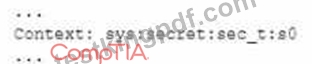
Which of the following describes the correct order of labels shown in the output above?
- A. User identity, role, type, and MLS level
- B. Role, user identity, object, and MLS level
- C. Object MLS level, role, and type
- D. Object, user identity, role, and MLS level
- E. Role, type MLS level, and user identity
Answer: A
Explanation:
SELinux contexts are typically made up of several components, including the user identity, role, type (also known as domain or type), and MLS (Multi-Level Security) level. The context format is user:role:type:level. In the given output sys:secret:sec_t:s0, 'sys' represents the user identity,
'secret' is the role, 'sec_t' is the type, and 's0' is the MLS level. Understanding SELinux contexts is critical for managing Mandatory Access Control (MAC) in GNU/Linux systems to protect against unauthorized access.
NEW QUESTION # 103
While investigating a security event, an analyst finds evidence that a user opened an email attachment from an unknown source. Shortly after the user opened the attachment, a group of servers experienced a large amount of network and resource activity. Upon investigating the servers, the analyst discovers the servers were encrypted by ransomware that is demanding payment within 48 hours or all data will be destroyed. The company has no response plans for ransomware.
Which of the following is the NEXT step the analyst should take after reporting the incident to the management team?
- A. Isolate the servers to prevent the spread.
- B. Pay the ransom within 48 hours.
- C. Request that the affected servers be restored immediately.
- D. Notify law enforcement.
Answer: A
Explanation:
Isolating the servers is the best immediate action to take after reporting the incident to the management team, as it can limit the damage and contain the ransomware infection. Paying the ransom is not advisable, as it does not guarantee the recovery of the data and may encourage further attacks. Notifying law enforcement is a possible step, but not the next one after reporting. Requesting that the affected servers be restored immediately may not be feasible or effective, as it depends on the availability and integrity of backups, and it does not address the root cause of the attack. Verified References:
https://www.comptia.org/blog/what-is-ransomware-and-how-to-protect-yourselfhttps://www.comptia.org/certific
NEW QUESTION # 104
Which of the following best explain why organizations prefer to utilize code that is digitally signed? (Select two).
- A. It integrates with DRMs.
- B. It provides increased confidentiality.
- C. It provides origin assurance.
- D. It verifies the recipient's identity.
- E. It ensures the code is free of malware.
- F. It verifies integrity.
Answer: C,F
Explanation:
Option A (Origin assurance):Digital signatures ensure that the code originates from a trusted source.
Option B (Integrity verification):Digital signatures verify that the code has not been tampered with since it was signed.
Option C (Confidentiality):Digital signatures do not provide encryption or confidentiality.
Option D (DRMs):Digital signatures are not specifically related to Digital Rights Management.
Option E (Recipient verification):Digital signatures validate the sender, not the recipient.
Option F (Free of malware):While digital signatures verify integrity, they cannot guarantee that the code is free of malware.
Reference:
CompTIA CASP+ Exam Objective 2.1: Implement cryptographic solutions to protect application integrity.
CASP+ Study Guide, 5th Edition, Chapter 9, Digital Signatures and Code Signing.
NEW QUESTION # 105
A security engineer is concerned about the threat of side-channel attacks The company experienced a past attack that degraded parts of a SCADA system, causing a fluctuation to 20,000rpm from its normal operating range As a result, the part deteriorated more quickly than the mean time to failure A further investigation revealed the attacker was able to determine the acceptable rpm range, and the malware would then fluctuate the rpm until the pan failed Which of the following solutions would be best to prevent a side-channel attack in the future?
- A. Installing online hardware sensors
- B. Air gapping important ICS and machines
- C. Installing a SIEM agent on the endpoint
- D. Implementing a HIDS
Answer: B
Explanation:
Air gapping, which means physically isolating a secure network from unsecured networks, including the public internet, is one of the most effective ways to prevent side-channel attacks. By creating an air gap, you remove the pathways that an attacker might exploit to gain unauthorized access to sensitive systems and manipulate them, as in the case of the SCADA system mentioned.
NEW QUESTION # 106
A security architect is improving a healthcare organization's security posture. Most of the software is cloud-based, but some old applications are still running on a server on-site. Medical devices using such applications require very low latency. The most important consideration isconfidentiality, followed byavailability, and thenintegrity. Which of the following is thefirst stepthe security architect should implement to protect PII?
- A. Move the application to a CSP.
- B. Move the application server to a network load balancing cluster.
- C. Enable encryption at rest on medical devices.
- D. Install FIM on the application server.
Answer: C
Explanation:
Comprehensive and Detailed in-Depth
Context:
Confidentialityis the highest priority, as the primary goal is toprotect PII (Personally Identifiable Information).
Availabilityis the second priority, crucial due to thelow latency requirementof medical devices.
Integrityis the third priority, essential to maintain accurate patient data.
The environment consists ofon-site applicationsinteracting with medical devices, wherecloud migration is not feasibledue to latency concerns.
Why the Correct Answer is C (Enable encryption at rest on medical devices):
Sinceconfidentialityis the top priority, enablingencryption at reston devices ensures thatsensitive data is protectedeven if the devices are compromised.
Medical devices can storePII locally, andencryption at restensures that even if physical or unauthorized access occurs, the data remainsconfidential.
Encrypting data at rest mitigates the risk of data leakage in scenarios likedevice theft or unauthorized access.
Given that the primary goal isconfidentiality, this action aligns with theCIA triadpriorities mentioned.
Why the Other Options Are Incorrect:
A . Move the application server to a network load balancing cluster:
This primarily addressesavailability, notconfidentiality.
Moving to a load-balanced setup may improveuptimebut doesnot directly protect PII.
B . Move the application to a CSP (Cloud Service Provider):
While cloud migration can offerenhanced security, it contradicts thelow latency requirementfor medical devices.
Transferring sensitive healthcare data to the cloud might introducelatency issuesand compromiseavailability.
D . Install FIM (File Integrity Monitoring) on the application server:
FIM primarily addressesintegrityby detecting changes in files but doesnot protect confidentiality.
Monitoring changes to filesdoes not encrypt or secure data at rest.
Best Practice:
In healthcare environments wherePII and medical data are stored locally, always implementencryption at restto ensure data remainsprotected and confidential.
TheHIPAAregulation also mandates encryption for protectingelectronic protected health information (ePHI), reinforcing the need for this step.
Extract from CompTIA SecurityX CAS-005 Study Guide:
TheCompTIA SecurityX CAS-005 Official Study Guideemphasizes that whenconfidentialityis the highest priority,data encryption at restis essential for protectingsensitive information. In healthcare environments wherePII and medical data are involved, encryption is anon-negotiable requirementto meet compliance standards.
NEW QUESTION # 107
In order to save money, a company has moved its data to the cloud with a low-cost provider. The company did not perform a security review prior to the move; however, the company requires all of its data to be stored within the country where the headquarters is located. A new employee on the security team has been asked to evaluate the current provider against the most important requirements. The current cloud provider that the company is using offers:
- Only multitenant cloud hosting
- Minimal physical security
- Few access controls
- No access to the data center
The following information has been uncovered:
- The company is located in a known floodplain. which flooded last
year.
- Government regulations require data to be stored within the country.
Which of the following should be addressed FIRST?
- A. Establish a new memorandum of understanding with the cloud provider.
- B. Update the disaster recovery plan to account for natural disasters.
- C. Establish a new service-level agreement with the cloud provider.
- D. Provision services according to the appropriate legal requirements.
Answer: D
NEW QUESTION # 108
......
Pass CompTIA CAS-004 exam - questions - convert Tets Engine to PDF: https://www.testkingpdf.com/CAS-004-testking-pdf-torrent.html
Use Real CAS-004 Dumps Free Sample Questions and Practice Test Engine: https://drive.google.com/open?id=1Cz1epOHpy3CHd9iJyjxMZcjK4TZOuK61
