

Updated May-2026 Pass DP-100 Exam - Real Practice Test Questions
Download Free Microsoft DP-100 Real Exam Questions
NEW QUESTION # 80
You create machine learning models by using Azure Machine Learning.
You plan to train and score models by using a variety of compute contexts. You also plan to create a new compute resource in Azure Machine Learning studio.
You need to select the appropriate compute types.
Which compute types should you select? To answer, drag the appropriate compute types to the correct requirements. Each compute type may be used once, more than once, or not at all. You may need to drag the split bar between panes or scroll to view content.
NOTE: Each correct selection is worth one point.
Answer:
Explanation:
Explanation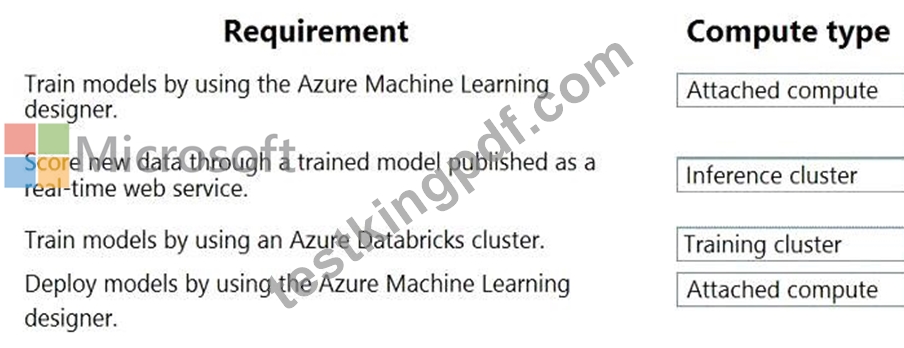
Box 1: Attached compute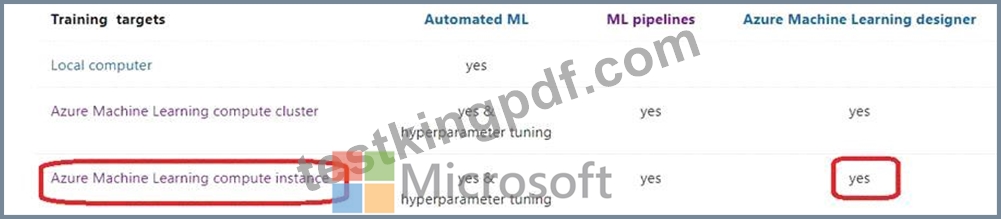
Box 2: Inference cluster
Box 3: Training cluster
Box 4: Attached compute
NEW QUESTION # 81
You train classification and regression models by using automated machine learning.
You must evaluate automated machine learning experiment results. The results include how a classification model is making systematic errors in its predictions and the relationship between the target feature and the regression model's predictions. You must use charts generated by automated machine learning.
You need to choose a chart type for each model type.
Which chart types should you use? To answer, select the appropriate options in the answer area.
NOTE: Each correct selection is worth one point.
Answer:
Explanation:
NEW QUESTION # 82
You are developing a deep learning model by using TensorFlow. You plan to run the model training workload on an Azure Machine Learning Compute Instance.
You must use CUDA-based model training.
You need to provision the Compute Instance.
Which two virtual machines sizes can you use? To answer, select the appropriate virtual machine sizes in the answer area.
NOTE: Each correct selection is worth one point.
Answer:
Explanation:
Reference:
https://www.infoworld.com/article/3299703/what-is-cuda-parallel-programming-for-gpus.html
NEW QUESTION # 83
You plan to implement a two-step pipeline by using the Azure Machine Learning SDK for Python.
The pipeline will pass temporary data from the first step to the second step.
You need to identify the class and the corresponding method that should be used in the second step to access temporary data generated by the first step in the pipeline.
Which class and method should you identify? To answer, select the appropriate options in the answer area.
NOTE: Each correct selection is worth one point
Answer:
Explanation:
Explanation
NEW QUESTION # 84
You create an Azure Machine Learning dataset. You use the Azure Machine Learning designer to transform the dataset by using an Execute Python Script component and custom code.
You must upload the script and associated libraries as a script bundle.
You need to configure the Execute Python Script component.
Which configurations should you use? To answer, select the appropriate options in the answer area.
NOTE Each correct selection is worth one point.
Answer:
Explanation:
Explanation:
NEW QUESTION # 85
You plan to use Hyperdrive to optimize the hyperparameters selected when training a model. You create the following code to define options for the hyperparameter experiment

For each of the following statements, select Yes if the statement is true. Otherwise, select No. NOTE: Each correct selection is worth one point.
Answer:
Explanation:
Reference:
https://docs.microsoft.com/en-us/python/api/azureml-train-core/azureml.train.hyperdrive.hyperdriveconfig
https://docs.microsoft.com/en-us/azure/machine-learning/how-to-tune-hyperparameters
NEW QUESTION # 86
You need to identify the methods for dividing the data according to the testing requirements.
Which properties should you select? To answer, select the appropriate options in the answer area.
NOTE: Each correct selection is worth one point.
Answer:
Explanation: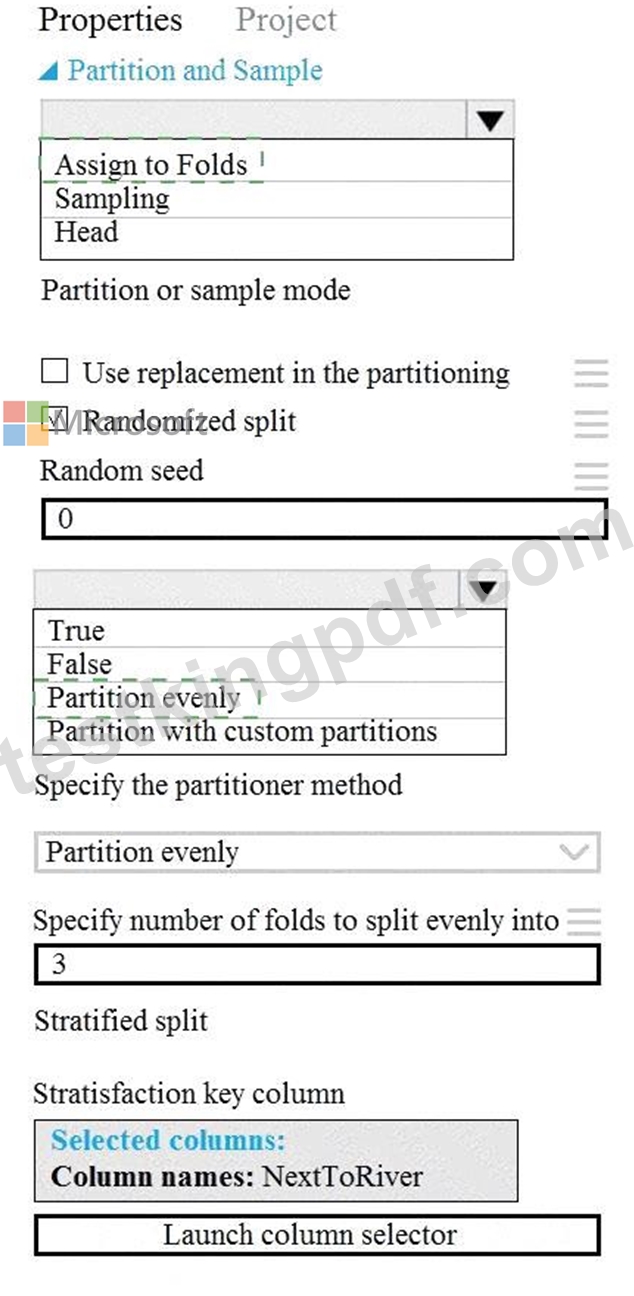
Explanation:

Scenario: Testing
You must produce multiple partitions of a dataset based on sampling using the Partition and Sample module in Azure Machine Learning Studio.
Box 1: Assign to folds
Use Assign to folds option when you want to divide the dataset into subsets of the data. This option is also useful when you want to create a custom number of folds for cross-validation, or to split rows into several groups.
Not Head: Use Head mode to get only the first n rows. This option is useful if you want to test a pipeline on a small number of rows, and don't need the data to be balanced or sampled in any way.
Not Sampling: The Sampling option supports simple random sampling or stratified random sampling. This is useful if you want to create a smaller representative sample dataset for testing.
Box 2: Partition evenly
Specify the partitioner method: Indicate how you want data to be apportioned to each partition, using these options:
Partition evenly: Use this option to place an equal number of rows in each partition. To specify the number of output partitions, type a whole number in the Specify number of folds to split evenly into text box.
Reference:
https://docs.microsoft.com/en-us/azure/machine-learning/algorithm-module-reference/partition-and-sample
NEW QUESTION # 87
You have a feature set containing the following numerical features: X, Y, and Z.
The Poisson correlation coefficient (r-value) of X, Y, and Z features is shown in the following image:
Use the drop-down menus to select the answer choice that answers each question based on the information presented in the graphic.
NOTE: Each correct selection is worth one point.
Answer:
Explanation:
Explanation:
Box 1: 0.859122
Box 2: a positively linear relationship
+1 indicates a strong positive linear relationship
-1 indicates a strong negative linear correlation
0 denotes no linear relationship between the two variables.
References:
https://docs.microsoft.com/en-us/azure/machine-learning/studio-module-reference/compute-linear-correlation
NEW QUESTION # 88
You manage an Azure Machine Learning workspace. You submit a training job with the Azure Machine Learning Python SDK v2. You must use MLflow to log metrics, model parameters, and mode! artifacts automatically when training a model.
You start by writing the following code segment:
For each of the following statements, select Yes If the statement is true. Otherwise, select No.
Answer:
Explanation:
NEW QUESTION # 89
You create an Azure Machine Learning compute resource to train models. The compute resource is configured as follows:
* Minimum nodes: 2
* Maximum nodes: 4
You must decrease the minimum number of nodes and increase the maximum number of nodes to the following values:
* Minimum nodes: 0
* Maximum nodes: 8
You need to reconfigure the compute resource.
What are three possible ways to achieve this goal? Each correct answer presents a complete solution.
NOTE: Each correct selection is worth one point.
- A. Use the Azure portal.
- B. Run the update method of the AmlCompute class in the Python SDK.
- C. Use the Azure Machine Learning studio.
- D. Run the refresh_state() method of the BatchCompute class in the Python SDK.
- E. Use the Azure Machine Learning designer.
Answer: A,B,C
Explanation:
A: You can manage assets and resources in the Azure Machine Learning studio.
B: The update(min_nodes=None, max_nodes=None, idle_seconds_before_scaledown=None) of the AmlCompute class updates the ScaleSettings for this AmlCompute target.
C: To change the nodes in the cluster, use the UI for your cluster in the Azure portal.
Reference:
https://docs.microsoft.com/en-us/python/api/azureml-core/azureml.core.compute.amlcompute(class)
NEW QUESTION # 90
You are creating a new experiment in Azure Machine Learning Studio. You have a small dataset that has missing values in many columns. The data does not require the application of predictors for each column. You plan to use the Clean Missing Data.
You need to select a data cleaning method.
Which method should you use?
- A. Replace using Probabilistic PCA
- B. Normalization
- C. Replace using MICE
- D. Synthetic Minority Oversampling Technique (SMOTE)
Answer: A
Explanation:
Replace using Probabilistic PCA: Compared to other options, such as Multiple Imputation using Chained Equations (MICE), this option has the advantage of not requiring the application of predictors for each column.
Instead, it approximates the covariance for the full dataset. Therefore, it might offer better performance for datasets that have missing values in many columns.
References:
https://docs.microsoft.com/en-us/azure/machine-learning/studio-module-reference/clean-missing-data
NEW QUESTION # 91 
You must use the Azure Machine Learning SDK to interact with data and experiments in the workspace.
You need to configure the config.json file to connect to the workspace from the Python environment.
Which two additional parameters must you add to the config.json file in order to connect to the workspace?
Each correct answer presents part of the solution.
NOTE: Each correct selection is worth one point.
- A. Key
- B. region
- C. subscription_Id
- D. resource_group
- E. Login
Answer: C,D
Explanation:
Explanation
To use the same workspace in multiple environments, create a JSON configuration file. The configuration file saves your subscription (subscription_id), resource (resource_group), and workspace name so that it can be easily loaded.
The following sample shows how to create a workspace.
from azureml.core import Workspace
ws = Workspace.create(name='myworkspace',
subscription_id='<azure-subscription-id>',
resource_group='myresourcegroup',
create_resource_group=True,
location='eastus2'
)
Reference:
https://docs.microsoft.com/en-us/python/api/azureml-core/azureml.core.workspace.workspace
NEW QUESTION # 92
Note: This question is part of a series of questions that present the same scenario. Each question in the series contains a unique solution that might meet the stated goals. Some question sets might have more than one correct solution, while others might not have a correct solution.
After you answer a question in this section, you will NOT be able to return to it. As a result, these questions will not appear in the review screen.
You create an Azure Machine Learning service datastore in a workspace. The datastore contains the following files:
* /data/2018/Q1.csv
* /data/2018/Q2.csv
* /data/2018/Q3.csv
* /data/2018/Q4.csv
* /data/2019/Q1.csv
All files store data in the following format:
id,f1,f2,I
1,1,2,0
2,1,1,1
3,2,1,0
4,2,2,1
You run the following code:
You need to create a dataset named training_data and load the data from all files into a single data frame by using the following code:
Solution: Run the following code:
Does the solution meet the goal?
- A. Yes
- B. No
Answer: B
Explanation:
Use two file paths.
Use Dataset.Tabular_from_delimeted, instead of Dataset.File.from_files as the data isn't cleansed.
Note:
A FileDataset references single or multiple files in your datastores or public URLs. If your data is already cleansed, and ready to use in training experiments, you can download or mount the files to your compute as a FileDataset object.
A TabularDataset represents data in a tabular format by parsing the provided file or list of files. This provides you with the ability to materialize the data into a pandas or Spark DataFrame so you can work with familiar data preparation and training libraries without having to leave your notebook. You can create a TabularDataset object from .csv, .tsv, .parquet, .jsonl files, and from SQL query results.
Reference:
https://docs.microsoft.com/en-us/azure/machine-learning/how-to-create-register-datasets
NEW QUESTION # 93
You need to define an evaluation strategy for the crowd sentiment models.
Which three actions should you perform in sequence? To answer, move the appropriate actions from the list of actions to the answer area and arrange them in the correct order.
Answer:
Explanation:
Explanation:
Scenario:
Experiments for local crowd sentiment models must combine local penalty detection data.
Crowd sentiment models must identify known sounds such as cheers and known catch phrases. Individual crowd sentiment models will detect similar sounds.
Note: Evaluate the changed in correlation between model error rate and centroid distance In machine learning, a nearest centroid classifier or nearest prototype classifier is a classification model that assigns to observations the label of the class of training samples whose mean (centroid) is closest to the observation.
References:
https://en.wikipedia.org/wiki/Nearest_centroid_classifier
https://docs.microsoft.com/en-us/azure/machine-learning/studio-module-reference/sweep-clustering
NEW QUESTION # 94
You define a datastore named ml-data for an Azure Storage blob container. In the container, you have a folder named train that contains a file named data.csv. You plan to use the file to train a model by using the Azure Machine Learning SDK.
You plan to train the model by using the Azure Machine Learning SDK to run an experiment on local compute.
You define a DataReference object by running the following code:
You need to load the training data.
Which code segment should you use?

- A. Option D
- B. Option B
- C. Option E
- D. Option C
- E. Option A
Answer: C
Explanation:
Explanation
Example:
data_folder = args.data_folder
# Load Train and Test data
train_data = pd.read_csv(os.path.join(data_folder, 'data.csv'))
Reference:
https://www.element61.be/en/resource/azure-machine-learning-services-complete-toolbox-ai
NEW QUESTION # 95
You are performing clustering by using the K-means algorithm.
You need to define the possible termination conditions.
Which three conditions can you use? Each correct answer presents a complete solution.
NOTE: Each correct selection is worth one point.
- A. The sum of distances between centroids reaches a maximum.
- B. The residual sum of squares (RSS) rises above a threshold.
- C. A fixed number of iterations is executed.
- D. Centroids do not change between iterations.
- E. The residual sum of squares (RSS) falls below a threshold.
Answer: A,B,C
NEW QUESTION # 96
You are moving a large dataset from Azure Machine Learning Studio to a Weka environment.
You need to format the data for the Weka environment.
Which module should you use?
- A. Convert to Dataset
- B. Convert to CSV
- C. Convert to ARFF
- D. Convert to SVMLight
Answer: C
Explanation:
Explanation/Reference:
Explanation:
Use the Convert to ARFF module in Azure Machine Learning Studio, to convert datasets and results in Azure Machine Learning to the attribute-relation file format used by the Weka toolset. This format is known as ARFF.
The ARFF data specification for Weka supports multiple machine learning tasks, including data preprocessing, classification, and feature selection. In this format, data is organized by entites and their attributes, and is contained in a single text file.
References:
https://docs.microsoft.com/en-us/azure/machine-learning/studio-module-reference/convert-to-arff Testlet 1 Case study Overview You are a data scientist in a company that provides data science for professional sporting events. Models will use global and local market data to meet the following business goals:
Understand sentiment of mobile device users at sporting events based on audio from crowd reactions.
Assess a user's tendency to respond to an advertisement.
Customize styles of ads served on mobile devices.
Use video to detect penalty events
Current environment
Media used for penalty event detection will be provided by consumer devices. Media may include
images and videos captured during the sporting event and shared using social media. The images and videos will have varying sizes and formats.
The data available for model building comprises of seven years of sporting event media. The sporting
event media includes; recorded video transcripts or radio commentary, and logs from related social media feeds captured during the sporting events.
Crowd sentiment will include audio recordings submitted by event attendees in both mono and stereo
formats.
Penalty detection and sentiment
Data scientists must build an intelligent solution by using multiple machine learning models for penalty
event detection.
Data scientists must build notebooks in a local environment using automatic feature engineering and
model building in machine learning pipelines.
Notebooks must be deployed to retrain by using Spark instances with dynamic worker allocation.
Notebooks must execute with the same code on new Spark instances to recode only the source of the
data.
Global penalty detection models must be trained by using dynamic runtime graph computation during
training.
Local penalty detection models must be written by using BrainScript.
Experiments for local crowd sentiment models must combine local penalty detection data.
Crowd sentiment models must identify known sounds such as cheers and known catch phrases.
Individual crowd sentiment models will detect similar sounds.
All shared features for local models are continuous variables.
Shared features must use double precision. Subsequent layers must have aggregate running mean
and standard deviation metrics available.
Advertisements
During the initial weeks in production, the following was observed:
Ad response rated declined.
Drops were not consistent across ad styles.
The distribution of features across training and production data are not consistent
Analysis shows that, of the 100 numeric features on user location and behavior, the 47 features that come from location sources are being used as raw features. A suggested experiment to remedy the bias and variance issue is to engineer 10 linearly uncorrelated features.
Initial data discovery shows a wide range of densities of target states in training data used for crowd
sentiment models.
All penalty detection models show inference phases using a Stochastic Gradient Descent (SGD) are
running too slow.
Audio samples show that the length of a catch phrase varies between 25%-47% depending on region
The performance of the global penalty detection models shows lower variance but higher bias when
comparing training and validation sets. Before implementing any feature changes, you must confirm the bias and variance using all training and validation cases.
Ad response models must be trained at the beginning of each event and applied during the sporting
event.
Market segmentation models must optimize for similar ad response history.
Sampling must guarantee mutual and collective exclusively between local and global segmentation
models that share the same features.
Local market segmentation models will be applied before determining a user's propensity to respond to
an advertisement.
Ad response models must support non-linear boundaries of features.
The ad propensity model uses a cut threshold is 0.45 and retrains occur if weighted Kappa deviated
from 0.1 +/- 5%.
The ad propensity model uses cost factors shown in the following diagram:
The ad propensity model uses proposed cost factors shown in the following diagram:
Performance curves of current and proposed cost factor scenarios are shown in the following diagram:
NEW QUESTION # 97
You create machine learning models by using Azure Machine Learning.
You plan to train and score models by using a variety of compute contexts. You also plan to create a new compute resource in Azure Machine Learning studio.
You need to select the appropriate compute types.
Which compute types should you select? To answer, drag the appropriate compute types to the correct requirements. Each compute type may be used once, more than once, or not at all. You may need to drag the split bar between panes or scroll to view content.
NOTE: Each correct selection is worth one point.
Answer:
Explanation:
NEW QUESTION # 98
You create a new Azure Machine Learning workspace with a compute cluster.
You need to create the compute cluster asynchronously by using the Azure Machine Learning Python SDK v2.
How should you complete the code segment? To answer, select the appropriate options in the answer area.
NOTE: Each correct selection is worth one point
Answer:
Explanation:
Explanation
NEW QUESTION # 99
......
DP-100 Dumps 100 Pass Guarantee With Latest Demo: https://www.testkingpdf.com/DP-100-testking-pdf-torrent.html
Pass Your Exam With 100% Verified DP-100 Exam Questions: https://drive.google.com/open?id=1DPfTDbfFjdzypKYwA2H8imiHOSGheFXi
