

Exam F5CAB1 Realistic Dumps Verified Questions Free [Jun 05, 2026]
Valid F5CAB1 Dumps for Helping Passing F5 Exam!
NEW QUESTION # 27
A BIG-IP Administrator is using Secure Copy Protocol (SCP) to transfer a TMOS image to the BIG-IP system in preparation for an upgrade.
To what directory should the file be transferred?
- A. /shared/images/
- B. /var/images/
- C. /local/images/
Answer: A
Explanation:
BIG-IP systems require all ISO images (base TMOS images and HotFix images) to be stored in a specific directory used for software installation:
/shared/images/
This directory:
* Is theonly supported locationfrom which the BIG-IP software installation system validates and installs ISO files
* Is accessible by both the GUI and TMSH installers
* Has adequate storage space allocated specifically for images
* Is part of the shared partition that persists across reboots
When transferring images via SCP, the administrator must copy them directly into/shared/images/so that:
* The GUI (System # Software Management # Available Images) can detect the image
* TMSH install software image commands can reference it
Other directories such as/local/images/or/var/images/are not valid storage paths for software images.
NEW QUESTION # 28
An organization is planning to upgrade a BIG-IP system from16.1.xto17.1.x.
For a successful upgrade, theService Check Datemust be equal to or newer than the License Check Date required for 17.1.x.
Which command will show the Service Check Date on the BIG-IP system being upgraded?
- A. grep "Service check date" /config/bigip.conf
- B. grep "Service check date" /config/bigip.license
- C. grep "Service check date" /config/BigDB.dat
- D. grep "Service check date" /config/svc_chk_date.dat
Answer: B
Explanation:
BIG-IP licensing information, including theService Check Date, is stored in the file:
/config/bigip.license
This file contains all license attributes downloaded from the F5 licensing server, including:
* License key
* Licensed modules
* Useful life date
* Service check date
TheService Check Datedetermines whether the system is eligible for upgrades to specific TMOS versions.
When reviewing upgrade readiness, administrators extract this value directly from the license file with:
grep "Service check date" /config/bigip.license
Why the other options are incorrect:
* /config/bigip.confstores BIG-IP configuration objects, not license metadata.
* /config/svc_chk_date.datisnota valid file in the licensing system; it does not contain license parameters.
* /config/BigDB.datstores internal database values, not licensing attributes.
Thus, only thebigip.licensefile contains the correct licensing information required for verifying upgrade eligibility.
NEW QUESTION # 29
A BIG-IP Administrator needs to purchase new licenses for a BIG-IP appliance.
The administrator needs to know:
* Whether a module is licensed
* The memory requirement for that module
Where should the administrator view this information in theSystem menu?
- A. Resource Provisioning
- B. Software Management
- C. Configuration - Device
- D. Configuration - OVSDB
Answer: A
NEW QUESTION # 30
What command will allow the BIG-IP Administrator to view theconfigured management IPof a BIG-IP system?
(Choose one.)
- A. tmsh show sys management-ip
- B. tmsh list sys management-ip
- C. tmsh list sys management-route
- D. tmsh list net self
Answer: B
Explanation:
Comprehensive and Detailed Explanation (Paraphrased)
The BIG-IP stores the configured management IP address as asystem configuration objectunder the/sys hierarchy.
To display configured (persistent) values, BIG-IP uses thetmsh list command, not show.
Why tmsh list sys management-ip is correct
* The management IP configuration is defined under:
* /sys management-ip
* Running:
* tmsh list sys management-ip
displays:
* The configured management IP address
* Netmask
* Associated attributes
This command shows theactual configured management IP, which is what the question asks for.
Why the other options are incorrect
A). tmsh show sys management-ip
* The show command is used for runtime statistics and status.
* management-ip is a configuration object, not a statistics object.
C). tmsh list sys management-route
* Displays management routing information, not the management IP address itself.
D). tmsh list net self
* Displays Self IPs used on the data plane.
* Does not show the management interface IP.
NEW QUESTION # 31
Refer to the exhibit.
What traffic will be permitted to reach the BIG-IP?
- A. FTP
- B. Telnet
- C. SSH
Answer: C
Explanation:
The exhibit shows the configuration of aSelf IPwith:
* Port Lockdown: Allow Custom
* ACustom Listthat includes the following TCP ports:
* 443
* 22
Meaning of these ports:
* TCP 443# HTTPS (TMUI - web-based management)
* TCP 22# SSH (command-line remote access)
No other TCP, UDP, or protocol entries are listed; therefore, only these two services are allowed to reach the BIG-IP via this Self IP.
Evaluating the answer choices:
Option
Service
Port
Allowed?
FTP
TCP 21
Not listed
Not allowed
SSH
TCP 22
Listed
Allowed
Telnet
TCP 23
Not listed
Not allowed
Thus,SSHis the only traffic permitted through this Self IP configuration.
NEW QUESTION # 32
How should a BIG-IP Administrator check theprovisioned CPU percentfor a module?
(Choose two.)
- A. By checking theDashboardoutput in the Statistics tab in the GUI.
- B. By runningtmsh show /sys cpuand reviewing the specific module provisioned output.
- C. By going toSystem / Resource Provisioningand hovering over the CPU section colors.
- D. By running thetopcommand and reviewing the output for the provisioned module.
- E. By runningtmsh show /sys provisionand reviewing the specific module in the output.
Answer: C,E
Explanation:
BIG-IP allocates CPU and memory resources based on module provisioning levels.
To view how much CPU a module is assigned, administrators must check provisioning information from:
C). GUI - System Resource Provisioning
This page visually displays CPU allocation via color-coded bars.
Hovering over the CPU bar shows:
* CPU usage percent per module
* Which modules share CPU cycles
* The system's total resource allocation
This is the primary GUI method.
D). tmsh show /sys provision
This command displays detailed module provisioning information including:
* Provisioned modules
* Their provisioning level
* CPU and memory allocation data
It is the authoritative CLI method for resource provisioning status.
Why the other options are incorrect:
A). top
* Shows real-time process usage, notprovisionedCPU allocation.
B). tmsh show /sys cpu
* Displays CPU runtime utilization, not per-module provisioning.
E). Statistics Dashboard
* Only shows traffic / system runtime metrics, not provisioning resource allocations.
Therefore,C and Dare correct.
NEW QUESTION # 33
The BIG-IP Administrator uses Secure Copy Protocol (SCP) to upload a TMOS image to the/shared/images/ directory in preparation for a TMOS upgrade.
After the upload is completed, what will the system dobeforethe image is shown in the GUI under:
System - Software Management - Image List?
- A. The system copies the image to /var/local/images/
- B. The system performs a reboot into a new partition
- C. The system verifies the internal checksum
Answer: C
Explanation:
When a TMOS image (.iso file) is uploaded into the/shared/images/directory, the BIG-IP performs an internal validation step before the ISO appears in the GUI.
1. The system verifies the internal checksum
* BIG-IP automatically reads the embedded checksum inside the ISO file
* Verifies integrity of the uploaded image
* Confirms the file is not corrupted or incomplete
* Ensures the image is a valid F5 TMOS software image
Only after this checksum verification succeeds does the image appear under:
System # Software Management # Image List
Why the other options are incorrect:
A). The system performs a reboot into a new partition
* Uploading an ISO file never triggers a reboot.
C). The system copies the image to /var/local/images/
* All valid TMOS images remain in/shared/images/.
* No copying occurs.
NEW QUESTION # 34
The BIG-IP Administrator needs to update access to the Configuration Utility to include the172.28.31.0/24and
172.28.65.0/24networks.
From the TMOS Shell (tmsh), which command should the BIG-IP Administrator use to complete this task?
- A. modify /sys httpd permit add { 172.28.31.0/255.255.255.0 172.28.65.0/255.255.255.0 }
- B. modify /sys httpd allow add { 172.28.31.0 172.28.65.0 }
- C. modify /sys httpd allow add { 172.28.31.0/255.255.255.0 172.28.65.0/255.255.255.0 }
Answer: C
Explanation:
Access to the BIG-IP Configuration Utility (TMUI) is controlled through the/sys httpd allowlist.
This list defines which IP addresses or subnets are allowed to connect to the management web interface.
To allow two new subnets-172.28.31.0/24and172.28.65.0/24-the administrator mustaddboth subnets to the existing list without removing current entries.
In tmsh, subnet entries must be specified innetwork/netmask format, for example:
172.28.31.0/255.255.255.0
The correct tmsh command to append these networks is:
modify /sys httpd allow add { 172.28.31.0/255.255.255.0 172.28.65.0/255.255.255.0 } Why the other options are incorrect:
Option B:
* IPs are listed without masks, which is invalid for subnet-based access control.
* The system requiresnetwork/netmaskformat.
Option C:
* The command uses permit instead of allow, which is not a valid attribute of /sys httpd.
* The correct keyword must beallow.
Thus, onlyOption Acorrectly adds both permitted subnets in the proper tmsh format.
NEW QUESTION # 35
Which two items demonstrate thecreation of a new volumefor software images?
(Choose two.)
- A. tmsh install software image /shared/images/BIGIP-<version>.iso volume HD1.5 create-volume
- B. tmsh install sys software image /shared/images/BIGIP-<version>.iso volume HD1.5 create-volume
- C. tmsh install /sys software image BIGIP-<version>.iso volume HD1.5 create-volume
- D. Using the GUI, go toSystem > Disk Management, selectNew Volume. In the pop-up window, type the name or number of the new volume and clickApply.
- E. Using the GUI, go toSystem > Software Management > Available Images > Install, and in the Install Software Image pop-up window, type the new volume name or number and clickInstall.
Answer: A,D
Explanation:
In BIG-IP, software images are installed onboot volumes(for example, HD1.1, HD1.2, HD1.3, etc.).
To install software on anew volume, the administrator must instruct the system to create a new boot location before installation.
There are two correct ways to create a new volume:
A). tmsh command (with correct syntax)
tmsh install software image /shared/images/BIGIP-<version>.iso volume HD1.5 create-volume This syntax correctly includes:
* install software image
* full path to ISO (/shared/images/...)
* volume name (HD1.5)
* create-volumekeyword
This instructs BIG-IP to create the new boot volume as part of the installation.
C). Using the GUI # System > Disk Management
From the Disk Management menu, the administrator can:
* Select "New Volume"
* Enter the volume identifier (e.g., HD1.5)
* Apply changes
This GUI method is officially supported and explicitly creates a new boot volume before installing the software.
Why the other options are incorrect:
B). Incorrect tmsh syntax
* Missing /shared/images/ path
* Incorrect command structure
D). Incorrect command structure
* Missing required keywords and correct command hierarchy
E). Software Management # Install does NOT create volumes
* This installs to anexistingvolume only
* The GUI install dialog does not create new boot volumes
Thus, onlyOption AandOption Cproperly create a new software volume.
NEW QUESTION # 36
For security reasons, a BIG-IP Administrator needs to specify allowable IP ranges for access to the Configuration Utility (WebUI).
The exhibit shows the User Administration section of the Configuration Utility.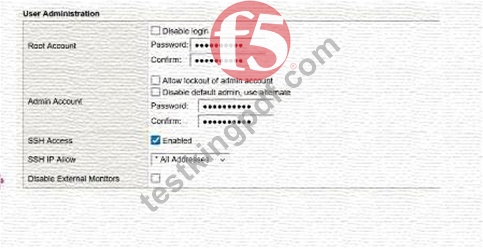
The administrator could not find any setting that explicitly restricts access to the Configuration Utility.
Which one of the following is a reason for that?
- A. To avoid locking out the administrator, recent versions of BIG-IP no longer allow restricting administrator access to the Configuration Utility by source IP address
- B. Restricting access to the Configuration Utility can only be done from the Command Line Interface
- C. The administrator needs to switch to the "Advanced" view mode in order to display the relevant setting
- D. The administrator must restrict access by IP address for SSH, which will implicitly restrict access to the Configuration Utility
Answer: B
Explanation:
The screenshot shown is from theUser Administrationsection of the BIG-IP GUI.
This section controls:
* Root and Admin passwords
* SSH Access
* SSH IP Allow settings
However,it does not contain any controls for restricting access to the WebUI (TMUI).
BIG-IP does not provide TMUI access restrictions from this part of the GUI.
Access to the web-based Configuration Utility is controlled by thehttpd allow list, configured through TMSH:
tmsh modify /sys httpd allow { <IP/subnet> }
This setting is not displayed in the User Administration panel, and in many BIG-IP versions, the httpd allow list isonly configurable from the CLI, not the GUI.
Therefore, the administrator cannot find the setting in the screen shown because:
* TMUI access restriction isnotlocated in this GUI section
* It must be configured usingtmshunder/sys httpd allow
This is whyOption Ais correct.
NEW QUESTION # 37
Refer to the exhibit.
What traffic will be permitted to reach the BIG-IP?
- A. FTP
- B. Telnet
- C. SSH
Answer: C
Explanation:
The exhibit shows the configuration of aSelf IPwith:
* Port Lockdown: Allow Custom
* ACustom Listthat includes the following TCP ports:
* 443
* 22
Meaning of these ports:
* TCP 443# HTTPS (TMUI - web-based management)
* TCP 22# SSH (command-line remote access)
No other TCP, UDP, or protocol entries are listed; therefore, only these two services are allowed to reach the BIG-IP via this Self IP.
Evaluating the answer choices:
Option
Service
Port
Allowed?
FTP
TCP 21
Not listed
#Not allowed
SSH
TCP 22
Listed
#Allowed
Telnet
TCP 23
Not listed
#Not allowed
Thus,SSHis the only traffic permitted through this Self IP configuration.
NEW QUESTION # 38
Refer to the exhibit.
An organization has purchased a BIG-IP license that includes all available modules but has chosen to provision only the modules they require.
The exhibit displays the current resource allocation from theSystem # Resource Provisioningpage.
Based on the information provided, which F5 modules have been provisioned?
- A. TMM, DNS, APS
- B. LTM, APM
- C. LTM, DNS, APM
- D. DNS, APM
Answer: C
Explanation:
The exhibit shows theCurrent Resource Allocationfor:
* CPU
* Disk
* Memory
In particular, theMemory Allocationbar displays the modules that are currently provisioned.
Memory is the most reliable indicator because BIG-IP allocates memoryonlyto modules that are actively provisioned.
From the exhibit:
* MGMT(Management) - always present
* TMM(Traffic Management Microkernel) - indicatesLTM is provisioned
* GTM- this label indicates that theDNS moduleis provisioned (GTM = Global Traffic Manager, now called DNS)
* APM- explicitly shown, indicatingAccess Policy Manageris provisioned
Therefore, the provisioned modules are:
* LTM(implied by TMM allocation)
* DNS/GTM
* APM
This matchesOption C: LTM, DNS, APM.
NEW QUESTION # 39
A secondary administrator has been granted access to a BIG-IP device through itsManagement Interface, but is unable to access theConfiguration Utility (WebUI).
What command can be run from the CLI to capture the network traffic on themanagement interfaceand troubleshoot the issue?
(Choose two.)
- A. tcpdump -i 0.0 -n port 443
- B. tcpdump -i eth0 -n port 443
- C. tcpdump -i mgmt -n port 443
- D. tcpdump -i management -n port 443
- E. tcpdump -i tun0 -n port 443
Answer: B,C
Explanation:
The BIG-IP has two distinct planes:
* Management-plane# handled entirely by the management interface (MGMT)
* Data-plane (TMM)# handles Self IPs, VLAN interfaces, and traffic processing To capture traffic on the management interface, only the management-side NICs may be used:
* mgmt# Logical name for the management interface
* eth0# Physical Linux interface mapped to the management port on most BIG-IP platforms Both of these correctly capture inbound/outbound WebUI (HTTPS/443) traffic on the management port.
Why the correct answers are A and B
A). tcpdump -i eth0 -n port 443
* On BIG-IP appliances and VMs, the management port maps toeth0at the Linux OS level.
* Capturing on eth0 correctly shows HTTPS traffic to the WebUI.
B). tcpdump -i mgmt -n port 443
* mgmtis the BIG-IP alias for the management interface.
* This is thepreferredand most explicit capture interface for management-plane packet captures.
Why the other options are incorrect:
C). tcpdump -i 0.0
* Interface0.0is the TMM switch interface used for data-plane packet captures.
* Itdoes NOTcapture management-plane traffic.
D). tcpdump -i tun0
* Used for tunnel interfaces (IPsec, VXLAN, etc.)
* Not related to management access.
E). tcpdump -i management
* There isnointerface named management on BIG-IP.
* The correct names are mgmt or eth0.
NEW QUESTION # 40
How can the BIG-IP Administrator tell when anunlicensed modulehas been provisioned?
- A. A BIG-IP does not allow unlicensed modules to be provisioned.
- B. AProvisioning Warningwill be displayed in the GUI in the upper left corner.
- C. When provisioning an unlicensed module, a warning will appear.
Answer: B
Explanation:
The BIG-IP system has built-in licensing enforcement.
If an administrator provisions a module that the device isnot licensedto run, the system will still allow the provisioning action to occurinitially, but the system detects the mismatch and displays an alert.
What actually happens:
* The GUI places awarning bannerin theupper-left cornerlabeled something similar to:"Provisioning Warning"
* This appears immediately after provisioning a module that is not included in the active license.
* The system remains in an "inconsistent state" until the module is disabled again or the license is updated.
This is the visual cue BIG-IP uses to indicate that a module was provisioned without valid licensing.
Why the other options are incorrect:
A). "A BIG-IP does not allow unlicensed modules to be provisioned."
* Not true. BIG-IPdoesallow provisioning, but warns afterward.
B). "A warning will appear when provisioning an unlicensed module."
* The warning doesnotappear during the provisioning step itself.
* It appearsafter provisioning, in the main GUI, as a system banner.
NEW QUESTION # 41
The monitoring team reports that the SNMP server is unable to poll data from a BIG-IP device.
What information will help the BIG-IP Administrator determine whether the issue originates from the BIG-IP system?
- A. The "Traffic Group" setting must use a floating Traffic Group.
- B. The "Port Lockdown" setting is preventing the SNMP server from polling data from the BIG-IP.
- C. The configuration on the exhibit is correct and other options should be explored.
- D. The "VLAN / Tunnel" setting must allow All Vlans.
Answer: B
Explanation:
The exhibit shows aSelf IPwith:
* VLAN:Data
* Port Lockdown:Allow None
Impact of "Allow None" on SNMP
When a Self IP is configured with:
Port Lockdown: Allow None
the BIG-IP blocksallservices and ports except a few hardcoded HA communication ports.
This means:
* UDP/161 (SNMP)is blocked
* UDP/162 (SNMP traps)is blocked
* The SNMP server cannot poll or receive data from the BIG-IP through this Self IP SNMP relies on access through the Self IP if out-of-band (mgmt interface) is not used.
Thus, the issue is directly caused byPort Lockdown = Allow None, which prevents SNMP communication.
Why the other options are incorrect:
B). Traffic Group must use a floating Traffic Group
* SNMP polling doesnotrequire floating Self IPs.
* Floating groups apply to HA failover IPs, not SNMP functionality.
C). VLAN/Tunnel must allow All VLANs
* Self IPs are always bound to a VLAN; SNMP doesnotrequire All VLANs.
* As long as the Self IP belongs to a reachable VLAN, SNMP can work.
D). Configuration is correct
* It is not correct:Allow Noneblocks SNMP and is the problem.
NEW QUESTION # 42
When logged into thebash shellof a BIG-IP system, which of the following commands will display the management-ip address?
(Choose two.)
- A. show mgmt ip
- B. list / sys management-ip
- C. tmsh list /sys management-ip
- D. ifconfig mgmt
Answer: C,D
Explanation:
When logged into thebash shellof a BIG-IP system, there are two valid ways to view themanagement-ip address:
A). tmsh list /sys management-ip
* Even from the bash shell, the administrator can enter a tmsh command by typing:
* tmsh list /sys management-ip
* This displays:
* Management IP address
* Netmask
* Any configured management routes
* This is theofficial tmsh methodfor viewing the management-ip configuration.
C). ifconfig mgmt
* In the underlying Linux OS, the management interface maps to themgmtinterface.
* Running:
* ifconfig mgmt
displays:
* Assigned management IP
* Netmask
* Link-level status
* This is a valid Linux-level method used frequently for troubleshooting.
Why the other options are incorrect:
B). show mgmt ip
* Not a valid bash or tmsh command on BIG-IP.
D). list / sys management-ip
* Missing thetmshprefix.
* In bash, this will generate a syntax error.
* The correct form requires:
tmsh list /sys management-ip
NEW QUESTION # 43
A BIG-IP Administrator needs to verify the state of equipment in the data center.
A BIG-IP appliance has asolid yellow indicatoron the status LED.
How should the administrator interpret this LED indicator?
- A. A warning-level alarm condition is present
- B. Appliance is a standby member in a device group
- C. Appliance is halted or in End-User Diagnostic (EUD) mode
- D. A power supply is NOT operating properly
Answer: A
Explanation:
BIG-IP hardware platforms use chassis LEDs to indicate system health states.
Asolid yellow status LEDtypically indicates awarning condition, such as:
* A non-critical hardware alert
* A temperature threshold nearing limit
* A minor fan or sensor irregularity
* Other non-fatal environmental or system conditions
This state reflects awarning-level alarm, meaning the unit is operational but requires investigation.
Why the other options are incorrect
A). Halted or EUD mode
* This is associated with different LED patterns (usually flashing conditions or specific color codes), not a solid yellow status LED.
B). Standby in device group
* HA state is not indicated by the chassis status LED.
* Standby status is alogicaldevice state, not a hardware LED state.
D). Power supply failure
* Power supply indicators use separate LEDs located on each power module (usually flashing amber/red), not the system status LED.
Thus, asolid yellow status indicatorsignifies awarning-level alarm.
NEW QUESTION # 44
When is theLicense Service Check Dateenforced on a BIG-IP system?
- A. After editing a virtual server
- B. During system startup
- C. During a software install
Answer: C
Explanation:
TheService Check Datedetermines whether a particular software version is allowed to run under the device's license.
* When installing or upgrading TMOS, the installer checks theService Check Datestored in the BIG-IP license file.
* If the license date isolderthan the minimum required for the target version, the software installation is blocked.
* This check happensspecifically during a software install, not during routine device operations.
Editing virtual servers or system startup do not trigger this validation.
Thus, the enforcement happensduring software installation.
NEW QUESTION # 45
An F5 VE has been deployed into a VMware environment via an OVF file.
An administrator wants to configure the management IP address so the VE can be accessed for further setup.
Which two are valid methods for configuring the management-ip address? (Choose two.)
- A. Log into the remote console and configure the management IP by running theconfigexecutable.
- B. Log into the remote console and configure the management IP by running thesetupcommand.
- C. Log into the remote console and configure the management IP through TMSH using:
create ltm management-ip <ip address>/<mask> - D. Log into the remote console and configure the management IP through TMSH using:
create sys management-ip <ip address>/<mask>
Answer: A,D
Explanation:
A newly deployed BIG-IP Virtual Edition (VE) in VMware requires initial configuration of itsmanagement- ipaddress so it can be accessed over the network. F5 provides several valid mechanisms during initial console access:
A). Running the config utility
* The config script is available on new BIG-IP installations and VE deployments.
* It launches a guided text-based wizard allowing configuration of:
* Management IP
* Netmask
* Default route
* This is a standard and recommended method during first-time setup.
B). Using TMSH with create sys management-ip
* Administrators can enter TMSH directly from the console and run:
* create sys management-ip <ip>/<mask>
* The management-ip object resides undersys, not under ltm or any other module.
* This is the correct tmsh method for defining the management interface address.
Why the other options are incorrect:
C). create ltm management-ip
* There isnosuch object under /ltm.
* LTM handles traffic objects (virtual servers, pools), not system management interfaces.
D). Running the setup command
* The setup command is used for general system configuration butdoes not configure the management- ip.
* It is not the supported method for initial management IP assignment on VE deployments.
Therefore, the valid methods are running theconfigutility and using thesys management-ipcommand within TMSH.
NEW QUESTION # 46
The BIG-IP Administrator wants to manage the newly built F5 system through anin-band Self-IP.
The administrator has configured a VLAN and Self-IP and can ping the IP from their workstation, but cannot access the system viaSSHorHTTPS.
Whatport lockdownsettings should the BIG-IP Administrator use to allow management access on the Self-IP?
(Choose two.)
- A. The Self-IP port lockdown behavior could be adjusted toAllow Default
- B. The Self-IP port lockdown behavior could be adjusted toAllow All
- C. The Self-IP port lockdown behavior could be adjusted toAllow Management
- D. The Self-IP port lockdown behavior could be adjusted toAllow Mgmt
Answer: C,D
Explanation:
Self-IPs include a security feature calledPort Lockdown, which restricts which services respond on that Self- IP.
By default, Self-IPs block management access (SSH and HTTPS/TMUI), meaning an administrator cannot manage the device through in-band Self-IPs unless explicitly allowed.
Allow Mgmt / Allow Management
These settings enable only the management services required for administrative access, specifically:
* SSH (22)
* HTTPS/TMUI (443)
These options allow secure administration without opening unnecessary ports.
Why these are correct:
* They provide only the essential access for management.
* They follow F5 security best practices when using in-band admin access.
* They donotexpose all services, reducing the attack surface.
Why the other options are incorrect:
A). Allow Default
* This allows only a minimal set of system-required ports (e.g., failover, config sync), not SSH or HTTPS.
* Administrator access would still fail.
B). Allow All
* Opens all ports on the Self-IP, which isnot secure.
* Exposes services that should remain restricted.
Therefore,Allow Mgmt / Allow Managementare the correct choices.
NEW QUESTION # 47
For an upgrade of a standalone BIG-IP, a maintenance window is available in which brief interruptions are allowed.
Actions with no impact can be done outside the maintenance window.
When should a license reactivation be performed?
- A. After the maintenance window.
- B. During the maintenance window.
- C. Before the maintenance window.
Answer: C
Explanation:
License reactivation updates the BIG-IP device's license file to ensure:
* TheService Check Dateis current
* The device is eligible to install the intended TMOS version
* Any module entitlement updates are received
Reactivationdoes not interrupt trafficand does not require a reboot, making it safe to performbeforethe maintenance window.
F5 best practices state:
* Performall non-impact tasks priorto the scheduled maintenance window
* Leave the window available for activities that require rebooting, such as the software installation itself Since license reactivation isnon-disruptive, it should be donebeforethe upgrade window starts.
NEW QUESTION # 48
The Port Lockdown feature prevents unwanted connection attempts to a Self IP.
Which three types of connection attempts areunaffectedby Port Lockdown settings?
- A. Defined virtual server traffic, Internet Control Message Protocol (ICMP), Centralized Management Infrastructure (CMI)
- B. Defined virtual server traffic, Secure Shell (SSH), Centralized Management Infrastructure (CMI)
- C. Centralized Management Infrastructure (CMI), Secure Shell (SSH), Internet Control Message Protocol (ICMP)
Answer: A
Explanation:
Port Lockdown controls which ports and protocols aSelf IPwill respond to.
However, certain traffic types bypass Port Lockdown for BIG-IP functionality and routing integrity.
The three types that areNOT affectedby Port Lockdown are:
1. Defined Virtual Server Traffic
Traffic destined to a Self IP that matches aconfigured virtual serveris always accepted by the BIG-IP, regardless of Port Lockdown settings.
This ensures that traffic processing does not break when administrators restrict Self-IP ports.
2. ICMP (Internet Control Message Protocol)
ICMP (such as ping, traceroute responses, etc.) always passes through a Self IP even when Port Lockdown is set to:
* Allow Default
* Allow None
* Allow Custom
F5 allows ICMP for reachability and diagnostic purposes independent of Port Lockdown rules.
3. Centralized Management Infrastructure (CMI)
CMI includes the internal HA services used for:
* Device Trust
* ConfigSync
* Failover
* Mirroring
These essential HA communications bypass Port Lockdown to prevent accidental cluster failure.
The well-known port for this traffic isTCP 4353, which is always permitted.
Why the other options are incorrect:
Option A:SSHisrestricted by Port Lockdown unless explicitly allowed.
Option B:Same issue - SSH does not bypass Port Lockdown.
OnlyDefined VS Traffic,ICMP, andCMIbypass Port Lockdown.
NEW QUESTION # 49
......
F5CAB1 Exam Dumps For Certification Exam Preparation: https://www.testkingpdf.com/F5CAB1-testking-pdf-torrent.html
Download Free F5 F5CAB1 Exam Questions & Answer : https://drive.google.com/open?id=1QyNuffomBk0FAeN0EE9NxK-hoQYG6Qxh
