

[Oct-2025] 200-201 Exam Questions and Valid 200-201 Dumps PDF
200-201 Brain Dump: A Study Guide with Tips & Tricks for passing Exam
Cisco 200-201 certification exam, also known as Understanding Cisco Cybersecurity Operations Fundamentals, is designed to validate an individual's knowledge and skills in the field of cybersecurity operations. 200-201 exam is ideal for those who want to pursue a career in cybersecurity or those who already work in the industry and want to enhance their skills and knowledge.
NEW QUESTION # 98
Which action should be taken if the system is overwhelmed with alerts when false positives and false negatives are compared?
- A. Redefine signature rules.
- B. Design criteria for reviewing alerts.
- C. Modify the settings of the intrusion detection system.
- D. Adjust the alerts schedule.
Answer: B
Explanation:
When a system is overwhelmed with alerts, designing criteria for reviewing alerts can help prioritize and manage them more effectively. This approach allows for a structured review process that can distinguish between false positives, false negatives, and legitimate alerts, reducing the overall number of alerts that require attention3.
NEW QUESTION # 99
What are the two differences between stateful and deep packet inspection? (Choose two )
- A. Stateful inspection is capable of TCP state tracking, and deep packet filtering checks only TCP source and destination ports
- B. Deep packet inspection is capable of TCP state monitoring only, and stateful inspection can inspect TCP and UDP.
- C. Deep packet inspection is capable of malware blocking, and stateful inspection is not
- D. Deep packet inspection operates on Layer 3 and 4. and stateful inspection operates on Layer 3 of the OSI model
- E. Stateful inspection is capable of packet data inspections, and deep packet inspection is not
Answer: A,C
Explanation:
* A: Stateful inspection tracks the state of network connections, such as TCP streams, to determine if a packet is part of an established connection.
* B: Deep packet inspection examines the data part (payload) of a packet and can identify, block, or
* reroute packets with specific types of malware. Stateful inspection does not inspect the payload for malware.
NEW QUESTION # 100
An organization's security team has detected network spikes coming from the internal network. An investigation has concluded that the spike in traffic was from intensive network scanning How should the analyst collect the traffic to isolate the suspicious host?
- A. based on the most used applications
- B. by most used ports
- C. based on the protocols used
- D. by most active source IP
Answer: D
Explanation:
To isolate the suspicious host that is performing intensive network scanning, the analyst should collect the traffic by most active source IP. This will help to identify the IP address of the host that is generating the most traffic and sending the most packets or bytes. The analyst can then apply filters or queries to analyze the traffic from that source IP and determine the nature and scope of the scanning activity. Reference:= Understanding Cisco Cybersecurity Operations Fundamentals (CBROPS) - Cisco, page 72; [Cisco CyberOps Associate CBROPS 200-201 Official Cert Guide], page 468
NEW QUESTION # 101 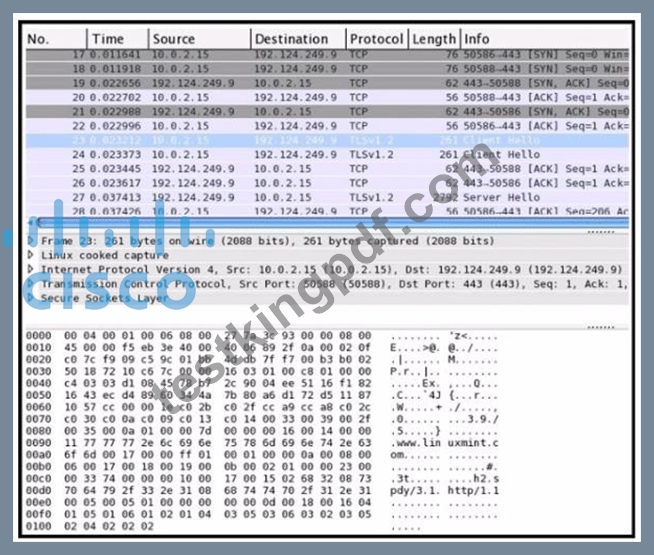
Refer to the exhibit Drag and drop the element names from the left onto the corresponding pieces of the PCAP file on the right.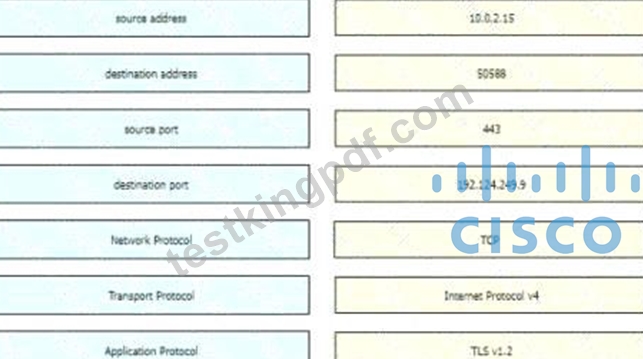
Answer:
Explanation: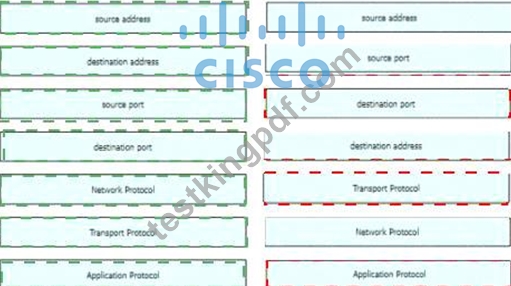
Explanation: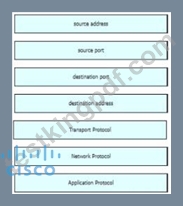
A screenshot of a computer Description automatically generated
NEW QUESTION # 102
A security analyst reviews the firewall and observes the large number of frequent events. The analyst starts the packet capture with the Wireshark and identifies that TCP port reuse was detected incorrectly as a TCP split-handshake attack by the firewall. How must an impact from this event be categorized?
- A. false negative
- B. false positive
- C. true positive
- D. true negative
Answer: C
NEW QUESTION # 103
Which two components reduce the attack surface on an endpoint? (Choose two.)
- A. full packet captures at the endpoint
- B. secure boot
- C. load balancing
- D. increased audit log levels
- E. restricting USB ports
Answer: B,E
Explanation:
Secure boot and restricting USB ports are two components that can reduce the attack surface on an endpoint. The attack surface is the sum of all paths for data into and out of the environment. Reducing the attack surface means minimizing the number and complexity of these paths, and thus reducing the opportunities for attackers to exploit vulnerabilities or gain unauthorized access. Secure boot is a feature that ensures that only trusted and verified code can run during the boot process, preventing malware or unauthorized software from compromising the system. Restricting USB ports is a policy that limits the use of USB devices, such as flash drives or external hard drives, that can introduce malware or exfiltrate data from the endpoint.
Reference: [Understanding Cisco Cybersecurity Operations Fundamentals (CBROPS) - Module 4: Network Intrusion Analysis], [Understanding Cisco Cybersecurity Operations Fundamentals (CBROPS) - Module 5: Security Policies and Procedures]
NEW QUESTION # 104
Which event is a vishing attack?
- A. impersonating a tech support agent during a phone call
- B. obtaining disposed documents from an organization
- C. setting up a rogue access point near a public hotspot
- D. using a vulnerability scanner on a corporate network
Answer: A
Explanation:
Vishing is an attack where fraudsters impersonate legitimate entities via phone calls to deceive individuals into providing sensitive information or performing actions that compromise security. Reference:= Cisco Cybersecurity Source Documents
NEW QUESTION # 105
Which incidence response step includes identifying all hosts affected by an attack?
- A. detection and analysis
- B. post-incident activity
- C. preparation
- D. containment, eradication, and recovery
Answer: A
Explanation:
The 'detection and analysis' phase of incident response includes identifying all hosts affected by an attack. This step involves analyzing the scope of the incident, determining which systems and data are impacted, and understanding the nature of the attack to inform subsequent containment and eradication efforts45.
Reference:
CrowdStrike's overview of incident response frameworks and steps4.
VCEGuide's explanation of incident response steps
NEW QUESTION # 106
Refer to the exhibit.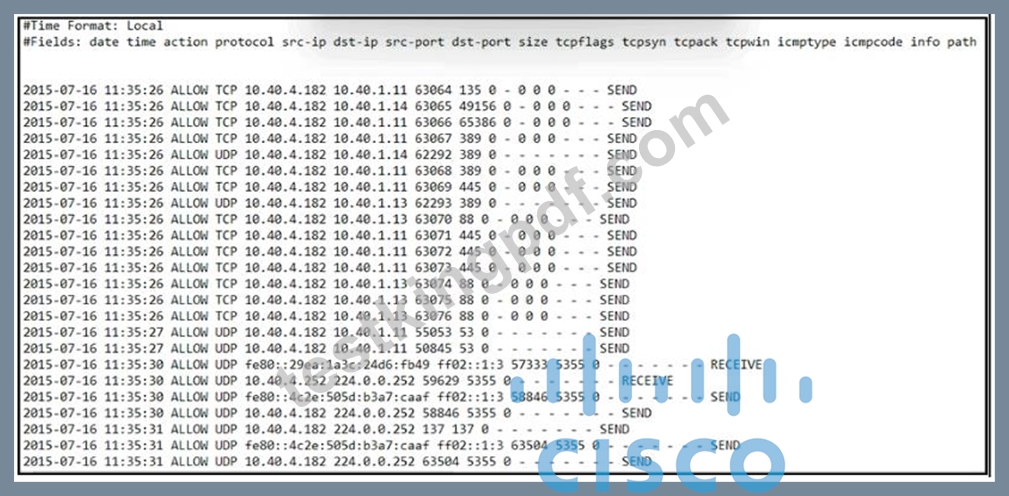
An engineer received an event log file to review. Which technology generated the log?
- A. firewall
- B. NetFlow
- C. IDS/IPS
- D. proxy
Answer: C
Explanation:
The exhibit shows an event log file with fields like date time action protocol src-ip dst-ip src-port dst-port etc., which are typical in Intrusion Detection Systems (IDS) or Intrusion Prevention Systems (IPS). These systems monitor network traffic for suspicious activity or violations of policies and produce reports as seen in the exhibit. Reference: Cisco Certified CyberOps Associate Overview
NEW QUESTION # 107
Which of these describes SOC metrics in relation to security incidents?
- A. probability of outage caused by the incident
- B. time it takes to assess the risks of the incident
- C. time it takes to detect the incident
- D. probability of compromise and impact caused by the incident
Answer: C
NEW QUESTION # 108
Which data format is the most efficient to build a baseline of traffic seen over an extended period of time?
- A. full packet capture
- B. NetFlow
- C. firewall event logs
- D. syslog messages
Answer: B
Explanation:
Section: Security Monitoring
NEW QUESTION # 109
According to the September 2020 threat intelligence feeds a new malware called Egregor was introduced and used in many attacks. Distnbution of Egregor is pnmanly through a Cobalt Strike that has been installed on victim's workstations using RDP exploits Malware exfiltrates the victim's data to a command and control server. The data is used to force victims pay or lose it by publicly releasing it. Which type of attack is described?
- A. insider threat
- B. whale-phishing
- C. malware attack
- D. ransomware attack
Answer: D
Explanation:
Ransomware is a type of malware that encrypts the victim's data and demands a ransom for the decryption key. The attacker may also threaten to publish or delete the data if the ransom is not paid. In this case, the Egregor malware is distributed through a Cobalt Strike, which is a penetration testing tool that can be used to deploy payloads on compromised systems. The malware exfiltrates the victim's data to a command and control server and uses it as leverage to extort money from the victim. Reference:= Cisco Cybersecurity Operations Fundamentals, Module 1: Security Concepts, Lesson 1.3: Common Network Application Operations and Attacks, Topic 1.3.3: Malware Attacks
NEW QUESTION # 110
A SOC analyst is investigating an incident that involves a Linux system that is identifying specific sessions. Which identifier tracks an active program?
- A. active process identification number
- B. runtime identification number
- C. application identification number
- D. process identification number
Answer: D
Explanation:
In the context of Linux systems, each active program is tracked using a process identification number (PID). The PID is a unique number that the system uses to refer to a specific process, which is an instance of an executed program. This allows the system and the SOC analyst to monitor and manage different processes, including those initiated by users, the system itself, or by applications.
NEW QUESTION # 111
Refer to the exhibit.
Which type of log is displayed?
- A. NetFlow
- B. IDS
- C. sys
- D. proxy
Answer: A
NEW QUESTION # 112
Which metric in CVSS indicates an attack that takes a destination bank account number and replaces it with a different bank account number?
- A. integrity
- B. availability
- C. scope
- D. confidentiality
Answer: A
Explanation:
The integrity metric in CVSS refers to the unauthorized modification or destruction of information. In this case, an attack that changes a destination bank account number with another one directly affects the accuracy and reliability of data, thus compromising its integrity. References := Cisco Cybersecurity
NEW QUESTION # 113
What does cyber attribution identify in an investigation?
- A. exploit of an attack
- B. threat actors of an attack
- C. cause of an attack
- D. vulnerabilities exploited
Answer: B
Explanation:
Cyber attribution identifies the threat actors of an attack in an investigation. Threat actors are the individuals, groups, organizations, or states that are responsible for conducting or sponsoring a cyberattack. Threat actors can have different motives, such as financial gain, espionage, sabotage, activism, or warfare. Cyber attribution can help investigators to determine the identity, location, affiliation, and motivation of the threat actors, as well as to hold them accountable and impose sanctions or legal actions. Reference:= Understanding Cisco Cybersecurity Operations Fundamentals (CBROPS) v1.0, Module 5: Security Policies and Procedures, Lesson 5.2: Incident Response, Topic 5.2.3: Cyber Attribution, page 5-14.
NEW QUESTION # 114
......
200-201 Exam Questions: Free PDF Download Recently Updated Questions: https://www.testkingpdf.com/200-201-testking-pdf-torrent.html
200-201 Certification Exam Dumps with 452 Practice Test Questions: https://drive.google.com/open?id=1-_XWC56p9v1aP1YEN84uaz015n8BG-b_
