

[Apr-2023] Exam Sure Pass Microsoft Certification with DP-500 exam questions
Real Microsoft DP-500 Exam Questions Study Guide
NEW QUESTION 29
You need to recommend a solution to ensure that sensitivity labels are applied. The solution must minimize administrative effort.
Which three actions should you include in the recommendation? Each correct answer presents part of the solution.
NOTE: Each correct selection is worth one point.
- A. In SQLDW. apply sensitivity labels to the columns in the Customer and CustomersWithProductScore tables.
- B. From the Power Bl Admin portal, set Apply sensitivity labels from data sources to their data in Power Bl to Enabled.
- C. From the Power Bl Admin portal, set Allow users to apply sensitivity labels for Power Bl content to Enabled.
- D. From the Power Bl Admin portal, set Make certified content discoverable to Enabled.
- E. In the Power Bl datasets, apply sensitivity labels to the columns in the Customer and CustomersWithProductScore tables.
Answer: C,D,E
Explanation:
A Synapse Analytics dedicated SQL pool is named SQLDW.
Customer contact data in SQLDW and the Power BI dataset must be labeled as Sensitive. Records must be kept of any users that use the sensitive data.
A (not B): Enable sensitivity labels
Sensitivity labels must be enabled on the tenant before they can be used in both the service and in Desktop.
To enable sensitivity labels on the tenant, go to the Power BI Admin portal, open the Tenant settings pane, and find the Information protection section.
In the Information Protection section, perform the following steps:
Open Allow users to apply sensitivity labels for Power BI content.
Enable the toggle.
D (not C): When data protection is enabled on your tenant, sensitivity labels appear in the sensitivity column in the list view of dashboards, reports, datasets, and dataflows.
E: Power BI Tenant Discovery Setting include Make certified content discoverable.
Reference:
https://docs.microsoft.com/en-us/power-bi/enterprise/service-security-apply-data-sensitivity-labels
https://support.nhs.net/knowledge-base/power-bi-guidance/
NEW QUESTION 30
You are optimizing a dataflow in a Power Bl Premium capacity. The dataflow performs multiple joins. You need to reduce the load time of the dataflow.
Which two actions should you perform? Each correct answer presents part of the solution. NOTE: Each correct selection is worth one point.
- A. Reduce the memory assigned to the dataflows.
- B. Execute non-foldable operations before foldable operations.
- C. Place the ingestion operations and transformation operations in a single dataflow.
- D. Place the ingestion operations and transformation operations in separate dataflows.
- E. Execute foldable operations before non-foldable operations.
Answer: D,E
Explanation:
Using the compute engine to improve performance
Take the following steps to enable workloads trigger the compute engine, and always improve performance:
For computed and linked entities in the same workspace:
Ensure you perform the operations that fold, such as merges, joins, conversion, and others.
For ingestion focus on getting the data into the storage as fast as possible, using filters only if they reduce the overall dataset size. It's best practice to keep your transformation logic separate from this step, and allow the engine to focus on the initial gathering of ingredients. Next, separate your transformation and business logic into a separate dataflow in the same workspace, using linked or computed entities; doing so allows for the engine to activate and accelerate your computations. In our analogy, it's like food preparation in the kitchen: food preparation is typically a separate and distinct step from gathering your raw ingredients, and a pre-requisite for putting the food in the oven. Similarly, your logic needs to be prepared separately before it can take advantage of the compute engine.
NEW QUESTION 31
You have an Azure Data Lake Storage Gen 2 container that stores more than 300,000 files representing hourly telemetry dat a. The data is organized in folders by the year, month, and day according to when the telemetry was captured.
You have the following query in Power Query Editor.
For each of the following statements, select Yes if the statement is true. Otherwise, select No.
NOTE: Each correct selection is worth one point
Answer:
Explanation:
Reference:
https://docs.microsoft.com/en-us/powerquery-m/table-selectrows
https://docs.microsoft.com/en-us/azure/data-lake-store/data-lake-store-comparison-with-blob-storage
NEW QUESTION 32
You are creating a Power 81 single-page report.
Some users will navigate the report by using a keyboard, and some users will navigate the report by using a
screen reader.
You need to ensure that the users can consume content on a report page in a logical order.
What should you configure on the report page?
- A. the bookmark order
- B. the X position
- C. the tab order
- D. the layer order
Answer: B
NEW QUESTION 33
You have an Azure Synapse Analytics serverless SQL pool.
You need to return a list of files and the number of rows in each file.
How should you complete the Transact-SQL statement? To answer, drag the appropriate values to the targets. Each value may be used once, more than once, or not at all. You may need to drag the split bar between panes or scroll to view content.
NOTE: Each correct selection is worth one point.
Answer:
Explanation:
Reference:
https://docs.microsoft.com/en-us/azure/synapse-analytics/sql/develop-openrowset
NEW QUESTION 34
You have an Azure Data Lake Storage Gen 2 container that stores more than 300,000 files representing hourly telemetry dat a. The data is organized in folders by the year, month, and day according to when the telemetry was captured.
You have the following query in Power Query Editor.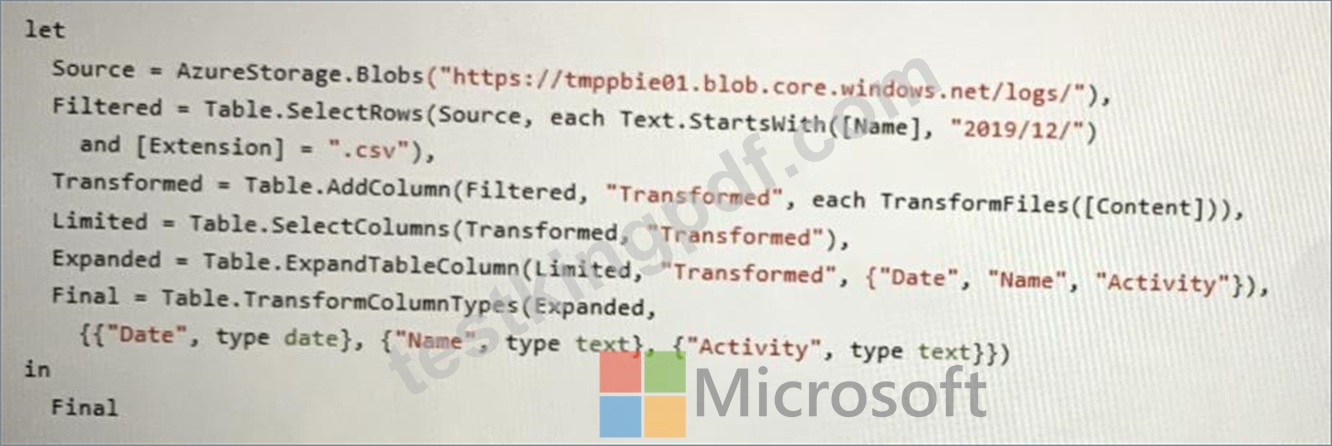
For each of the following statements, select Yes if the statement is true. Otherwise, select No.
NOTE: Each correct selection is worth one point
Answer:
Explanation:
Reference:
https://docs.microsoft.com/en-us/powerquery-m/table-selectrows
https://docs.microsoft.com/en-us/azure/data-lake-store/data-lake-store-comparison-with-blob-storage
NEW QUESTION 35
You are using Azure Synapse Studio to explore a dataset that contains data about taxi trips.
You need to create a chart that will show the total trip distance according to the number of passengers as
shown in the following exhibit.
How should you configure the chart? To answer, select the appropriate options in the answer area. NOTE:
Each correct selection is worth one point.
Answer:
Explanation:
NEW QUESTION 36
You are using GitHub as a source control solution for an Azure Synapse Studio workspace. You need to
modify the source control solution to use an Azure DevOps Git repository. What should you do first?
- A. Change the active branch.
- B. Disconnect from the GitHub repository.
- C. Change the workspace to live mode.
- D. Create a new pull request.
Answer: B
NEW QUESTION 37
You have the following Python code in an Apache Spark notebook.
Which type of chart will the code produce?
- A. a pie chart
- B. a bar chart
- C. a stacked bar chart
- D. an area chart
Answer: D
Explanation:
The matplotlib.pyplot.fill_between function fills the area between two horizontal curves.
The curves are defined by the points (x, y1) and (x, y2). This creates one or multiple polygons describing the filled area.
NEW QUESTION 38
You have a group of data scientists who must create machine learning models and run periodic experiments on a large dataset.
You need to recommend an Azure Synapse Analytics pool for the data scientists. The solution must minimize costs.
Which type of pool should you recommend?
- A. a dedicated SQL pool
- B. a Data Explorer pool
- C. an Apache Spark pool
- D. a serverless SQL pool
Answer: C
Explanation:
In Azure Synapse, training machine learning models can be performed on the Apache Spark Pools with tools like PySpark/Python, Scala, or .NET.
NEW QUESTION 39
You are using an Azure Synapse notebook to create a Python visual.
You run the following code cell to import a dataset named Iris.
A sample of the data is shown in the following table.
You need to create the visual shown in the exhibit. (Click the Exhibit tab.)
How should you complete the Python code? To answer, select the appropriate options in the answer area.
NOTE: Each correct selection is worth one point.
Answer:
Explanation:
NEW QUESTION 40
You have a deployment pipeline for a Power BI workspace. The workspace contains two datasets that use import storage mode.
A database administrator reports a drastic increase in the number of queries sent from the Power Bi service to an Azure SQL database since the creation of the deployment pipeline.
An investigation into the issue identifies the following:
One of the datasets is larger than 1 GB and has a fact table that contains more than 500 million rows.
When publishing dataset changes to development, test, or production pipelines, a refresh is triggered against the entire dataset.
You need to recommend a solution to reduce the size of the queries sent to the database when the dataset changes are published to development, test, or production.
What should you recommend?
- A. From Capacity settings in the Power Bi Admin portal, reduce the Max Intermediate Row Set Count setting.
- B. Request the authors of the deployment pipeline datasets to reduce the number of datasets republished during development.
- C. Configure the dataset to use a composite model that has a DirectQuery connection to the fact table.
- D. In the dataset, delete the fact table.
Answer: C
Explanation:
Previously in Power BI Desktop, when you used a DirectQuery in a report, no other data connections, whether DirectQuery or import, were allowed for that report. With composite models, that restriction is removed. A report can seamlessly include data connections from more than one DirectQuery or import data connection, in any combination you choose.
The composite models capability in Power BI Desktop consists of three related features:
* Composite models: Allows a report to have two or more data connections from different source groups, such as one or more DirectQuery connections and an import connection, two or more DirectQuery connections, or any combination thereof.
* Etc.
NEW QUESTION 41
You have a Power Bl report that contains the visual shown in the following exhibit.
You need to make the visual more accessible to users who have color vision deficiency. What should you do?
- A. Change the font color of values in the Sales column to white.
- B. Change the red background color to orange.
- C. Add icons to represent the sales status of each product.
- D. Add additional measures to the table values.
Answer: A
Explanation:
Themes, contrast and colorblind-friendly colors
You should ensure that your reports have enough contrast between text and any background colors.
Certain color combinations are particularly difficult for users with color vision deficiencies to distinguish. These include the following combinations:
**---> green and black
green and red
green and brown
blue and purple
green and blue
light green and yellow
blue and grey
green and grey
Avoid using these colors together in a chart, or on the same report page.
NEW QUESTION 42
You have a Power BI Premium capacity.
You need to increase the number of virtual cores associated to the capacity.
Which role do you need?
- A. Power Platform admin
- B. Power Bl workspace admin
- C. Power Bl admin
- D. capacity admin
Answer: C
Explanation:
Change capacity size
Power BI admins and global administrators can change Power BI Premium capacity. Capacity admins who are not a Power BI admin or global administrator don't have this option.
NEW QUESTION 43
You are implementing a reporting solution that has the following requirements:
* Reports for external customers must support 500 concurrent requests. The data for these reports is
approximately 7 GB and is stored in Azure Synapse Analytics.
* Reports for the security team use data that must have local security rules applied at the database level to
restrict access. The data being reviewed is 2 GB.
Which storage mode provides the best response time for each group of users?
- A. DirectQuery for the external customers and DirectQuery for the security team.
- B. DirectQuery for the external customers and import for the security team.
- C. Import for the external customers and DirectQuery for the security team.
- D. Import for the external customers and import for the security team.
Answer: B
NEW QUESTION 44
You have an Azure Synapse Analytics serverless SQL pool.
You need to return a list of files and the number of rows in each file.
How should you complete the Transact-SQL statement? To answer, drag the appropriate values to the targets. Each value may be used once, more than once, or not at all. You may need to drag the split bar between panes or scroll to view content.
NOTE: Each correct selection is worth one point.
Answer:
Explanation:
Reference:
https://docs.microsoft.com/en-us/azure/synapse-analytics/sql/develop-openrowset
NEW QUESTION 45
You have an Azure Synapse notebook.
You need to create the visual shown in the following exhibit.
How should you complete the code? To answer, select the appropriate options in the answer area.
NOTE: Each correct selection is worth one point.
Answer:
Explanation:
Reference:
https://matplotlib.org/3.1.1/api/_as_gen/matplotlib.pyplot.suptitle.html#matplotlib.pyplot.suptitle
NEW QUESTION 46
After you answer a question in this section, you will NOT be able to return to it. As a result, these questions
will not appear in the review screen.
You are using an Azure Synapse Analytics serverless SQL pool to query a collection of Apache Parquet files
by using automatic schema inference. The files contain more than 40 million rows of UTF-8-encoded business
names, survey names, and participant counts. The database is configured to use the default collation.
The queries use open row set and infer the schema shown in the following table.
You need to recommend changes to the queries to reduce I/O reads and tempdb usage.
Solution: You recommend using openrowset with to explicitly define the collation for businessName and
surveyName as Latim_Generai_100_BiN2_UTF8.
Does this meet the goal?
- A. Yes
- B. No
Answer: A
NEW QUESTION 47
You have a Power Bl dataset that has only the necessary fields visible for report development.
You need to ensure that end users see only 25 specific fields that they can use to personalize visuals.
What should you do?
- A. From Tabular Editor, create a new perspective.
- B. Hide all the fields in the dataset.
- C. From Tabular Editor, create a new role.
- D. Configure object-level security (OLS).
Answer: B
NEW QUESTION 48
You need to populate the CustomersWithProductScore table.
How should you complete the stored procedure? To answer, select the appropriate options in the answer area.
NOTE: Each correct selection is worth one point.
Answer:
Explanation:
NEW QUESTION 49
You have a kiosk that displays a Power Bl report page. The report uses a dataset that uses Import storage
mode. You need to ensure that the report page updates all the visuals every 30 minutes. Which two actions
should you perform? Each correct answer presents part of the solution. NOTE: Each correct selection is worth
one point.
- A. Add a Microsoft Power Automate visual to the report page.
- B. Enable Power Bl embedded.
- C. Configure the data sources to use DirectQuery.
- D. Configure the data sources to use a streaming dataset
- E. Select Auto page refresh.
- F. Enable the XMIA endpoint.
Answer: B,E
NEW QUESTION 50
You have an Azure Synapse Analytics serverless SQL pool and an Azure Data Lake Storage Gen2 account.
You need to query all the files in the 'csv/taxi/' folder and all its subfolders. All the files are in CSV format and have a header row.
How should you complete the query? To answer, select the appropriate options in the answer area.
NOTE: Each correct selection is worth one point.
Answer:
Explanation:
NEW QUESTION 51
You have an Azure Synapse workspace named Workspace1.
You need to use PySpark in a notebook to read data from a SQL pool as an Apache Spark DataFrame and
display the top five
How should you complete the code? To answer, select the appropriate options in the answer area.
NOTE: Each correct selection is worth one point.
Answer:
Explanation:
NEW QUESTION 52
You have a file named File1.txt that has the following characteristics:
* A header row
* Tab delimited values
* UNIX-style line endings
You need to read File1.txt by using an Azure Synapse Analytics serverless SQL pool.
Which query should you execute?

- A. Option D
- B. Option A
- C. Option C
- D. Option B
Answer: B
Explanation:
Use FIELDTERMINATOR ='\t' for tab.
Use ROWTERMINATOR ='\0x0A ' for UNIX-style line endings
Use FIRSTROW= 2 for a header row
Note: Using Row Terminators
The row terminator can be the same character as the terminator for the last field. Generally, however, a distinct row terminator is useful. For example, to produce tabular output, terminate the last field in each row with the newline character (\n) and all other fields with the tab character (\t).
If you want to output a line feed character only (LF) as the row terminator - as is typical on Unix and Linux computers - use hexadecimal notation to specify the LF row terminator. For example:
bcp -r '0x0A'
FIRSTROW
FIRSTROW =first_row Specifies the number of the first row to load. The default is 1. This indicates the first row in the specified data file. The row numbers are determined by counting the row terminators. FIRSTROW is 1-based.
Reference:
https://docs.microsoft.com/en-us/sql/t-sql/functions/openrowset-transact-sql
NEW QUESTION 53
......
Updated and Accurate DP-500 Questions for passing the exam Quickly: https://www.testkingpdf.com/DP-500-testking-pdf-torrent.html
Download Real DP-500 Exam Dumps for candidates. 100% Free Dump Files: https://drive.google.com/open?id=13RGYE6As-SC9t0AEb1HdzNrgIVpcu7q5
