

300-710 Training & Certification Get Latest CCNP Security Updated on Nov 01, 2025
Certification Training for 300-710 Exam Dumps Test Engine
Cisco 300-710 certification exam is a challenging and rigorous exam that requires a deep understanding of Cisco Firepower NGFW technology. Candidates must have a strong understanding of network security concepts, as well as experience working with Cisco Firepower technology. Passing this certification exam demonstrates a high level of expertise and proficiency in securing network infrastructures using Cisco Firepower technology.
Cisco 300-710 exam, also known as Securing Networks with Cisco Firepower, is a certification exam that tests your knowledge and skills in securing Cisco networks using Firepower technologies. 300-710 exam is designed for network security professionals who work with Cisco Firepower Next-Generation Firewall (NGFW), Firepower Threat Defense (FTD), and Firepower Management Center (FMC).
Cisco 300-710 exam consists of multiple-choice questions and simulations. The simulations are designed to test the candidate's ability to apply their knowledge to real-world scenarios. 300-710 exam is administered by Pearson VUE, a leading provider of computer-based testing services. Candidates can register for the exam through the Pearson VUE website and can take the exam at a Pearson VUE testing center.
NEW QUESTION # 129
Which two routing options are valid with Cisco Firepower Threat Defense? (Choose two.)
- A. BGPv4 in transparent firewall mode
- B. BGPv4 with nonstop forwarding
- C. ECMP with up to three equal cost paths across multiple interfaces
- D. BGPv6
- E. ECMP with up to three equal cost paths across a single interface
Answer: D,E
Explanation:
https://www.cisco.com/c/en/us/td/docs/security/firepower/601/configuration/guide/fpmc-config- guide-v601/fpmc-config-guide-v60_chapter_01100011.html

NEW QUESTION # 130
Which Firepower feature allows users to configure bridges in routed mode and enables devices to perform Layer 2 switching between interfaces?
- A. FlexConfig
- B. IRB
- C. BDI
- D. SGT
Answer: B
Explanation:
Reference: https://www.cisco.com/c/en/us/td/docs/security/firepower/620/relnotes/Firepower_System_Release_Notes_Version_620/new_features_and_functionality.html
NEW QUESTION # 131
Refer to the exhibit.
A systems administrator conducts a connectivity test to their SCCM server from a host machine and gets no response from the server. Which action ensures that the ping packets reach the destination and that the host receives replies?
- A. Modify the Snort rules to allow ICMP traffic.
- B. Configure a custom Snort signature to allow ICMP traffic after Inspection.
- C. Create an ICMP allow list and add the ICMP destination to remove it from the implicit deny list.
- D. Create an access control policy rule that allows ICMP traffic.
Answer: D
NEW QUESTION # 132
The event dashboard within the Cisco FMC has been inundated with low priority intrusion drop events, which are overshadowing high priority events. An engineer has been tasked with reviewing the policies and reducing the low priority events. Which action should be configured to accomplish this task?
- A. drop packet
- B. generate events
- C. drop connection
- D. drop and generate
Answer: A
Explanation:
Reference"
https://www.cisco.com/c/en/us/td/docs/security/firepower/620/configuration/guide/fpmc-config-guide-v62/worki
NEW QUESTION # 133
Which limitation applies to Cisco Firepower Management Center dashboards in a multidomain environment?
- A. Child domains can view but not edit dashboards that originate from an ancestor domain.
- B. Child domains have access to only a limited set of widgets from ancestor domains.
- C. Only the administrator of the top ancestor domain can view dashboards.
- D. Child domains cannot view dashboards that originate from an ancestor domain.
Answer: D
NEW QUESTION # 134
A network administrator manages a network with multiple firewalls in a data center. The administrator must change a next-generation firewall from routed to transparent mode. Which action must the administrator take to meet the requirement?
- A. Manually delete the interface configuration from the CLI.
- B. Create one or more bridge groups from the CLI.
- C. Deregister the firewall in Cisco Secure Firewall Management Center.
- D. Enter the configure firewall transparent command from the CLI.
Answer: C
Explanation:
Step 1. Deregister the Firepower Threat Defense device from the FMC.
Step 2. Access the Firepower Threat Defense device CLI, preferably from the console port.
Step 3. > configure firewall [routed | transparent]
Step 4. Re-register with the FMC
https://www.cisco.com/c/en/us/td/docs/security/firepower/70/configuration/guide/fpmc-config- guide-v70/transparent_or_routed_firewall_mode_for_firepower_threat_defense.html
NEW QUESTION # 135
A network administrator manages a network with multiple firewalls in a datacenter using Cisco Secure Firepower Management Center. The administrator must change a next-generation firewall from routed to transparent mode. Which action must the administrator take next to meet the requirement?
- A. Manually delete the interface configuration from the CLI.
- B. Enter the configure transparent firewall command from the CLI.
- C. Create one or more bridge groups from the CLI.
- D. Deregister the firewall in Cisco Secure Firewall Management Center.
Answer: D
NEW QUESTION # 136
A VPN administrator converted an instance of Cisco Secure Firewall Threat Defense, which is managed by Cisco Secure Firewall Management Center, from using LDAP to LDAPS for remote access VPN authentication. Which certificate must be added to allow for remote users to authenticate over the VPN?
- A. LDAPS server certificate must be added to Secure Firewall Management Center realms.
- B. LDAPS server certificate must be added to Secure Firewall Threat Defense.
- C. Secure Firewall Management Center certificate must be added to the LDAPS server.
- D. Secure Firewall Threat Defense certificate must be added to the LDAPS server.
Answer: B
NEW QUESTION # 137
A network administrator is migrating from a Cisco ASA to a Cisco FTD.
EIGRP is configured on the Cisco ASA but it is not available in the Cisco FMC.
Which action must the administrator take to enable this feature on the Cisco FTD?
- A. Enable advanced configuration options in the FMC.
- B. Configure EIGRP parameters using FlexConfig objects.
- C. Add the command feature eigrp via the FTD CLI.
- D. Create a custom variable set and enable the feature in the variable set.
Answer: B
NEW QUESTION # 138
What is the RTC workflow when the infected endpoint is identified?
- A. Cisco ISE instructs Cisco AMP to contain the infected endpoint.
- B. Cisco FMC instructs Cisco ISE to contain the infected endpoint.
- C. Cisco AMP instructs Cisco FMC to contain the infected endpoint.
- D. Cisco ISE instructs Cisco FMC to contain the infected endpoint.
Answer: B
NEW QUESTION # 139
An engineer is configuring two new Cisco Secure Firewall Threat Defense devices to replace the existing firewalls. Network traffic must be analyzed for intrusion events without impacting the traffic. What must the engineer implement next to accomplish the goal?
- A. Inline Pair in Tap mode
- B. ERSPAN Passive mode
- C. Passive mode
- D. Inline Pair mode
Answer: C
NEW QUESTION # 140
IT management is asking the network engineer to provide high-level summary statistics of the Cisco FTD appliance in the network. The business is approaching a peak season so the need to maintain business uptime is high. Which report type should be used to gather this information?
- A. Standard Report
- B. Malware Report
- C. Risk Report
- D. SNMP Report
Answer: A
NEW QUESTION # 141
Refer to the exhibit.
A company is deploying a pair of Cisco Secure Firewall Threat defence devices named FTD1 and FTD2.
FTD1 and FTD2 have been configured as an active/standby pair with a failover link but without a stateful link. What must be implemented next to ensure that users on the internal network still communicate with outside devices if FTD1 fails?
- A. Set maximum secured addresses to two on the switch interfaces on FTD1 and FTD2.
- B. Disable port security on the switch interfaces connected to FTD1 and FTD2.
- C. Configure the spanning-tree PortFasI feature on SW1 and FTD2
- D. Connect and configure a stateful link and thon deploy the changes.
Answer: D
Explanation:
In a failover configuration with Cisco Secure Firewall Threat Defense (FTD) devices, ensuring that users on the internal network can continue to communicate with outside devices if the primary device (FTD1) fails requires the implementation of a stateful failover link. The stateful failover link allows the secondary device (FTD2) to maintain session information and state data, ensuring seamless failover and minimizing disruptions.
Steps to implement a stateful failover link:
* Physically connect a stateful failover link between FTD1 and FTD2.
* Configure the stateful failover link in the FMC.
* Ensure that both devices are properly synchronized and that stateful failover is enabled.
* Deploy the changes to both FTD devices.
By configuring a stateful link, the secondary FTD can take over active sessions without requiring users to re- establish their connections, thus ensuring continuous communication.
References:Cisco Secure Firewall Threat Defense Configuration Guide, Chapter on Failover Configuration.
NEW QUESTION # 142
An engineer is attempting to create a new dashboard within the Cisco FMC to have a single view with widgets from many of the other dashboards. The goal is to have a mixture of threat and security related widgets along with Cisco Firepower device health information. Which two widgets must be configured to provide this information? (Choose two.)
- A. Appliance Status
- B. Correlation Information
- C. Intrusion Events
- D. Network Compliance
- E. Current Sessions
Answer: A,C
Explanation:
Reference:
https://www.cisco.com/c/en/us/td/docs/security/firepower/640/configuration/guide/fpmc-config-guide-v64/ dashboards.html#ID-2206-00000283
NEW QUESTION # 143 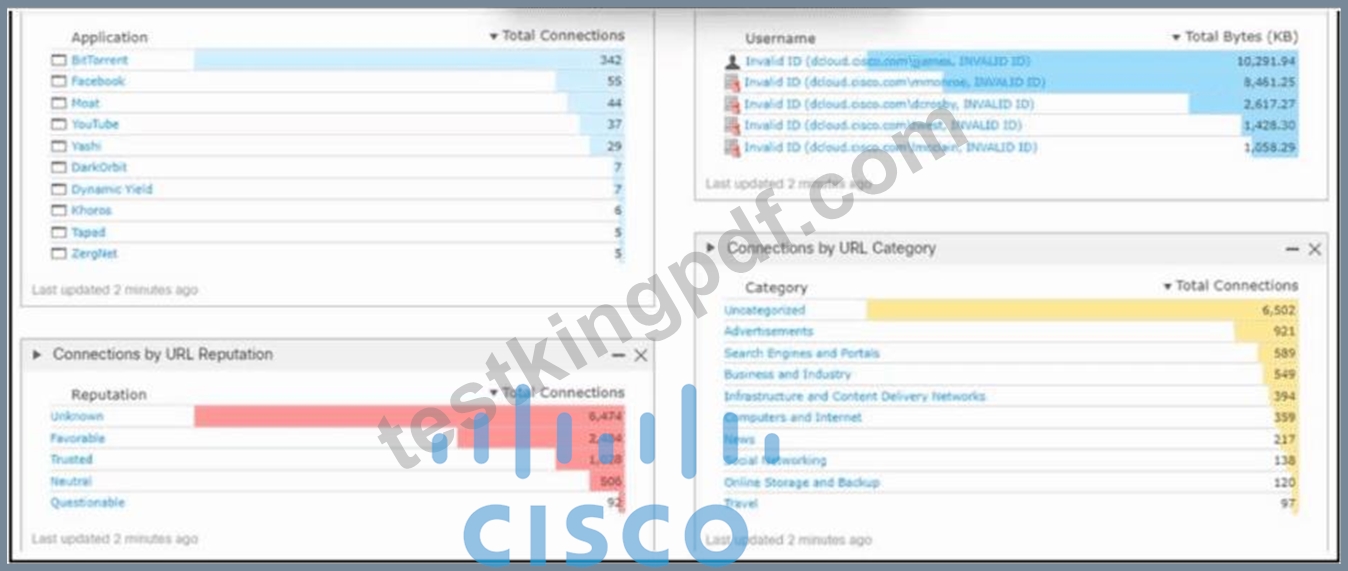


Refer to the exhibit. An engineer analyzes a Cisco Firepower Management Center dashboard. Which action must be taken by the user to decrease the risk of data loss?
- A. Block all the BitTorrent applications.
- B. Block the use of Dropbox.
- C. Stop all URLs that have an unknown reputation.
- D. Stop all the URLs that are uncategorized.
Answer: D
NEW QUESTION # 144
Refer to the exhibit.
And engineer is analyzing the Attacks Risk Report and finds that there are over 300 instances of new operating systems being seen on the network How is the Firepower configuration updated to protect these new operating systems?
- A. The administrator requests a Remediation Recommendation Report from Cisco Firepower
- B. The administrator manually updates the policies.
- C. Cisco Firepower automatically updates the policies.
- D. Cisco Firepower gives recommendations to update the policies.
Answer: D
Explanation:
Explanation
Ref:
https://www.cisco.com/c/en/us/td/docs/security/firepower/60/configuration/guide/fpmc-config-guide-v60/Tailori
NEW QUESTION # 145
Network users are experiencing Intermittent issues with internet access. An engineer ident med mat the issue Is being caused by NAT exhaustion. How must the engineer change the dynamic NAT configuration to provide internet access for more users without running out of resources?
- A. Convert the dynamic auto NAT rule to dynamic manual NAT.
- B. Configure fallthrough to interface PAT on 'he Advanced tab.
- C. Add an identity NAT rule to handle the overflow of users.
- D. Define an additional static NAT for the network object in use.
Answer: B
Explanation:
Explanation
Fallthrough to interface PAT is a feature that allows the dynamic NAT configuration to use the interface IP address as a last resort when the NAT pool is exhausted. This way, more users can access the internet without running out of resources. To enable this feature, the engineer must check the Enable PAT Fallback check box on the Advanced tab of the NAT rule editor1
NEW QUESTION # 146
Refer to the exhibit.
What must be done to fix access to this website while preventing the same communication to all other websites?
- A. Create an intrusion policy rule to have Snort allow port 80 to only 172.1.1 50.
- B. Create an intrusion policy rule to have Snort allow port 443 to only 172.1.1.50
- C. Create an access control policy rule to allow port 443 to only 172.1.1 50
- D. Create an access control policy rule to allow port 80 to only 172.1.1 50.
Answer: D
NEW QUESTION # 147
An engineer configures a network discovery policy on Cisco FMC. Upon configuration, it is noticed that excessive and misleading events filing the database and overloading the Cisco FMC.
A monitored NAT device is executing multiple updates of its operating system in a short period of time. What configuration change must be made to alleviate this issue?
- A. Increase the number of entries on the NAT device.
- B. Leave default networks.
- C. Change the method to TCP/SYN.
- D. Exclude load balancers and NAT devices.
Answer: D
NEW QUESTION # 148
Refer to the exhibit.

An engineer is analyzing a Network Risk Report from Cisco FMC. Which application must the engineer take immediate action against to prevent unauthorized network use?
- A. Kerberos
- B. YouTube
- C. TOR
- D. Chrome
Answer: C
NEW QUESTION # 149
An analyst is investigating a potentially compromised endpoint within the network and pulls a host report for the endpoint in question to collect metrics and documentation. What information should be taken from this report for the investigation?
- A. number of attacked machines, sources of the attack, and traffic patterns
- B. client applications by user, web applications, and user connections
- C. threat detections over time and application protocols transferring malware
- D. intrusion events, host connections, and user sessions
Answer: B
NEW QUESTION # 150
After deploying a network-monitoring tool to manage and monitor networking devices in your organization, you realize that you need to manually upload an MIB for the Cisco FMC. In which folder should you upload the MIB file?
- A. system/etc/DCEALERT.MIB
- B. /etc/sf/DCMIB.ALERT
- C. /sf/etc/DCEALERT.MIB
- D. /etc/sf/DCEALERT.MIB
Answer: D
NEW QUESTION # 151
When using Cisco Threat Response, which phase of the Intelligence Cycle publishes the results of the investigation?
- A. processing
- B. dissemination
- C. analysis
- D. direction
Answer: B
Explanation:
Disseminate: The dissemination phase publishes the results of the investigation or threat hunt.
This information is disseminated with a focus on the receivers of the information. At the tactical level, this information feeds back into the beginning of the F3EAD model, Find. Figure 3 illustrates the F3EAD model.
NEW QUESTION # 152
......
Step by Step Guide to Prepare for 300-710 Exam: https://www.testkingpdf.com/300-710-testking-pdf-torrent.html
CCNP Security 300-710 Real Exam Questions and Answers FREE Updated: https://drive.google.com/open?id=1PbKMaqnBADQznwXdvTCMHgixjHGKw2Yv
