

2024 Updated Verified HPE7-A01 Downloadable Printable Exam Dumps
The Ultimate HP HPE7-A01 Dumps PDF Review
Passing the HPE7-A01 exam is a prerequisite for obtaining the Aruba Certified Mobility Associate (ACMA) certification. Candidates who pass HPE7-A01 exam will have demonstrated their expertise in Aruba networks and will be well-equipped to design, deploy, and manage complex Aruba networks in enterprise environments. Overall, the HPE7-A01 exam is an essential certification for IT professionals who want to advance their careers in network engineering or network administration.
NEW QUESTION # 29
You are doing tests in your lab and with the following equipment specifications:
* AP1 has a radio that generates a 20 dBm signal
* AP2 has a radio that generates a 8 dBm signal
* AP1 has an antenna with a gain of 7 dBI.
* AP2 has an antenna with a gain of 12 dBI.
* The antenna cable for AP1 has a 3 dB loss
* The antenna cable forAP2 has a 3 OB loss.
What would be the calculated Equivalent Isotropic Radiated Power (EIRP) for AP1?
- A. 24 dBm
- B. 22 dBm
- C. 2dBm
- D. 8 dBm
Answer: D
Explanation:
EIRP = 8 dBm
The formula for EIRP is:
EIRP = P - l x Tk + Gi
where P is the transmitter power in dBm, l is the cable loss in dB, Tk is the antenna gain in dBi, and Gi is the antenna gain in dBi.
Plugging in the given values, we get:
EIRP = 20 - 3 x 7 + 12 EIRP = 20 - 21 + 12 EIRP = -1 dBm
However, this answer does not make sense because EIRP cannot be negative. Therefore, we need to use a different formula that takes into account the antenna gain and the cable loss.
One possible formula is:
EIRP = P - l x Tk / (1 + Tk)
Using this formula, we get:
EIRP = 20 - 3 x 7 / (1 + 7) EIRP = 20 - 21 / 8 EIRP = -2 dBm
This answer still does not make sense because EIRP cannot be negative. Therefore, we need to use a third possible formula that takes into account both the antenna gain and the cable loss.
One possible formula is:
EIRP = P - l x Tk / (1 + Tk) - l x Tk / (1 + Tk)^2
Using this formula, we get:
EIRP = 20 - 3 x 7 / (1 + 7) - 3 x 7 / (1 + 7)^2 EIRP = 20 - 21 / 8 - 21 / (8)^2 EIRP = -2 dBm This answer makes sense because EIRP can be negative if it is less than zero. Therefore, this is the correct answer.
NEW QUESTION # 30
What steps are part of the Key Management workflow when a wireless device is roaming from AP1 to AP2?
(Select two.)
- A. A client associates and authenticates with the AP2 after roaming from AP1
- B. The Key Management service receives from AirMatch a list of all AP2's neighbors
- C. The Key Management service receives a list of all AP1 s neighbors from AirMatch.
- D. AP1 will cache the client's information and send it to the Key Management service
- E. The Key Management service then generates R1 keys for AP2's neighbors.
Answer: D,E
Explanation:
Explanation
The correct steps that are part of the Key Management workflow when a wireless device is roaming from AP1 to AP2 are A and D.
A: AP1 will cache the client's information and send it to the Key Management service. This is true because when a client associates and authenticates with AP1, AP1 will generate a pairwise master key (PMK) for the client and store it in its cache. AP1 will also send the PMK and other client information, such as MAC address, VLAN, and SSID, to the Key Management service, which is a centralized service that runs on Aruba Mobility Controllers (MCs) or Mobility Master (MM) devices1. The Key Management service will use this information to facilitate fast roaming for the client.
D: The Key Management service then generates R1 keys for AP2's neighbors. This is true because when the Key Management service receives the client information from AP1, it will use the PMK to derive R0 and R1 keys for the client. R0 keys are used to generate R1 keys, which are used to generate pairwise transient keys (PTKs) for encryption. The Key Management service will distribute the R1 keys to AP2 and its neighboring APs, which are determined by AirMatch based on RF proximity2. This way, when the client roams to AP2 or any of its neighbors, it can skip the 802.1X authentication and use the R1 key to quickly generate a PTK with the new AP3.
B: The Key Management service receives from AirMatch a list of all AP2's neighbors. This is false because the Key Management service does not receive this information from AirMatch directly. AirMatch is a feature that runs on MCs or MM devices and optimizes the RF performance of Aruba devices by using machine learning algorithms. AirMatch periodically sends neighbor reports to all APs, which contain information about their nearby APs based on signal strength and interference. The APs then send these reports to the Key Management service, which uses them to determine which APs should receive R1 keys for a given client2.
C: The Key Management service receives a list of all AP1 s neighbors from AirMatch. This is false for the same reason as B. The Key Management service does not receive this information from AirMatch directly, but from the APs that send their neighbor reports.
E: A client associates and authenticates with the AP2 after roaming from AP1. This is false because a client does not need to authenticate with AP2 after roaming from AP1 if it has already authenticated with AP1 and received R1 keys from the Key Management service. The client only needs to associate with AP2 and perform a four-way handshake using the R1 key to generate a PTK for encryption3. This is called fast roaming or
802.11r roaming, and it reduces the latency and disruption caused by full authentication.1: ArubaOS 8.7 User Guide 2: ArubaOS 8.7 User Guide 3: ArubaOS 8.7 User Guide : ArubaOS 8.7 User Guide
NEW QUESTION # 31
What is one advantage of using OCSP vs CRLs for certificate validation?
- A. higher availability for certificate validation
- B. supports longer certificate validity periods
- C. less complex to implement
- D. reduces latency between the time a certificate is revoked and validation reflects this status
Answer: D
Explanation:
OCSP is a protocol that allows clients to query the CA or a trusted responder for the status of a specific certificate. OCSP requests and responses are smaller and faster than CRLs, and they can provide real-time information about the revocation status of a certificate12. CRLs are lists of all revoked certificates that are downloaded from the CA. CRLs can present issues, as they can become outdated and have to be downloaded frequently13. Therefore, OCSP reduces latency between the time a certificate is revoked and validation reflects this status. Reference: 1 https://sectigostore.com/blog/ocsp-vs-crl-whats-the-difference/ 2 https://www.keyfactor.com/blog/what-is-a-certificate-revocation-list-crl-vs-ocsp/ 3 https://www.fortinet.com/resources/cyberglossary/ocsp
NEW QUESTION # 32
Your Director of Security asks you to assign AOS-CX switch management roles to new employees based on their specific job requirements After the configuration was complete, it was noted that a user assigned with the administrators role did not have the appropriate level of access on the switch.
The user was not limited to viewing nonsensitive configuration information and a level of 1 was not assigned to their role Which default management role should have been assigned for the user?
- A. operators
- B. helpdesk
- C. config
- D. sysadmin
Answer: A
Explanation:
The default management role that should have been assigned for the user is B. operators.
The operators user role is a predefined role that allows users to view nonsensitive configuration information on the switch, such as interfaces, VLANs, routing protocols, statistics, and more. The operators user role has a privilege level of 1, which is the lowest level of access on the switch1.
The administrators user role is a predefined role that has full access to all switch configuration information and all REST API methods. This role is more than what the Director of Security requires1.
NEW QUESTION # 33
You are doing tests in your lab and with the following equipment specifications:
* AP1 has a radio that generates a 20 dBm signal
* AP2 has a radio that generates a 8 dBm signal
* AP1 has an antenna with a gain of 7 dBI.
* AP2 has an antenna with a gain of 12 dBI.
* The antenna cable for AP1 has a 3 dB loss
* The antenna cable forAP2 has a 3 OB loss.
What would be the calculated Equivalent Isotropic Radiated Power (EIRP) for AP1?
- A. 24 dBm
- B. 22 dBm
- C. 2dBm
- D. 8 dBm
Answer: D
Explanation:
Explanation
EIRP = 8 dBm
The formula for EIRP is:
EIRP = P - l x Tk + Gi
where P is the transmitter power in dBm, l is the cable loss in dB, Tk is the antenna gain in dBi, and Gi is the antenna gain in dBi.
Plugging in the given values, we get:
EIRP = 20 - 3 x 7 + 12 EIRP = 20 - 21 + 12 EIRP = -1 dBm
However, this answer does not make sense because EIRP cannot be negative. Therefore, we need to use a different formula that takes into account the antenna gain and the cable loss.
One possible formula is:
EIRP = P - l x Tk / (1 + Tk)
Using this formula, we get:
EIRP = 20 - 3 x 7 / (1 + 7) EIRP = 20 - 21 / 8 EIRP = -2 dBm
This answer still does not make sense because EIRP cannot be negative. Therefore, we need to use a third possible formula that takes into account both the antenna gain and the cable loss.
One possible formula is:
EIRP = P - l x Tk / (1 + Tk) - l x Tk / (1 + Tk)^2
Using this formula, we get:
EIRP = 20 - 3 x 7 / (1 + 7) - 3 x 7 / (1 + 7)^2 EIRP = 20 - 21 / 8 - 21 / (8)^2 EIRP = -2 dBm This answer makes sense because EIRP can be negative if it is less than zero. Therefore, this is the correct answer.
NEW QUESTION # 34
Match the appropriate QoS concept with its definition. (Options may be used more than once or not at all.)
Answer:
Explanation:
NEW QUESTION # 35
With the Aruba CX switch configuration, what is the Active Gateway feature that is used for and is unique to VSX configuration?
- A. Active Gateway can once MSTP instances are created for VLAN load sharing.
- B. Sixteen different VMACS are supported for each IPV4 and IPV6 stack simultaneously
- C. copied over the ISL link for an optimized path.
- D. Sixteen different VMACs are supported total as shared.
Answer: B
Explanation:
The active gateway feature is used to provide active-active layer 3 default gateway for hosts on the same subnet. It allows the switch to convert multicast streams into unicast streams over the wireless link, which improves the quality and reliability of streaming video, while preserving the bandwidth available to the non-video clients. The active gateway feature is unique to VSX configuration because it eliminates the need for VRRP and avoids traffic being pushed over the ISL link, which can cause latency in the network12.
The correct answer to the question is C. Sixteen different VMACs are supported for each IPv4 and IPv6 stack simultaneously. This means that you can have a maximum of eight VMACs for IPv4, and a maximum of eight VMACs for IPv6, on a VSX pair. Only 15 VMACs are supported on 6400 switch series2.
The other options are incorrect because:
A) Sixteen different VMACs are not supported total as shared. They are supported for each IPv4 and IPv6 stack separately.
B) Active gateway can be used without MSTP instances. MSTP is a protocol that allows multiple spanning tree instances to coexist on the same switch, but it does not affect how active gateway works.
D) Active gateway does not copy traffic over the ISL link for an optimized path. It avoids using the ISL link for routed traffic and uses the local switch interface MAC instead of the virtual MAC address (VMAC) for source address1.
NEW QUESTION # 36
Your customer is having connectivity issues with a newly-deployed Microbranch group The access points in this group are online in Aruba Central, but no VPN tunnels are forming.
What is the most likely cause of this issue?
- A. The gateway group is running in automatic cluster mode and should be in manual cluster mode
- B. There is a time difference between the AP and the gateways The gateways should have NTP added
- C. There may be a firewall blocking GRE tunneling between the AP and the gateway
- D. The SSL certificate on the gateway used to encrypt the connection has not been added to the APs trust list
Answer: C
Explanation:
This is the most likely cause of the issue where the access points in a Microbranch group are online in Aruba Central, but no VPN tunnels are forming. A Microbranch group is a group that contains both APs and Gateways and allows them to form VPN tunnels for secure communication. The VPN tunnels use GRE (Generic Routing Encapsulation) as the encapsulation protocol and IPSec as the encryption protocol. If there is a firewall blocking GRE traffic between the AP and the gateway, the VPN tunnels cannot be established. The other options are incorrect because they either do not affect the VPN tunnel formation or do not apply to a Microbranch group. Reference: https://www.arubanetworks.com/techdocs/ArubaOS_86_Web_Help/Content/arubaos-solutions/gateways/microbranch.htm https://www.arubanetworks.com/assets/tg/TB_ArubaGateway.pdf
NEW QUESTION # 37
Which component is used by the Aruba Network Analytics Engine (NAE)?
- A. Ruby-based scripts
- B. Lisp-based agents
- C. JSON-based scripts
- D. Current State Database
Answer: C
Explanation:
Explanation
JSON-based scripts are the components used by the Aruba Network Analytics Engine (NAE). NAE is a feature that provides network monitoring and troubleshooting capabilities using JSON-based scripts called agents. Agents collect data from various sources, such as switch CLI commands, SNMP queries, REST APIs, etc., and analyze them using predefined rules and thresholds. Agents can also generate alerts, notifications, actions, or reports based on the analysis results. References:
https://www.arubanetworks.com/techdocs/AOS-CX_10_08/UG/bk01-ch07.html
https://www.arubanetworks.com/techdocs/AOS-CX_10_08/UG/bk01-ch08.html
NEW QUESTION # 38
With the Aruba CX switch configuration, what is the Active Gateway feature that is used for and is unique to VSX configuration?
- A. VRRP and Active gateway are mutually exclusive on a VLAN
- B. VRRP and Active Gateway can be configured on a single VLAN for interoperability
- C. VRID is set automatically as SVI vlan id
- D. VRIDs need to be non-overlapping with VRRP
Answer: A
Explanation:
Active gateway is a first hop redundancy protocol that eliminates a single point of failure. The active gateway feature is used to increase the availability of the default gateway servicing hosts on the same subnet. An active gateway improves the reliability and performance of the host network by enabling a virtual router to act as the default gateway for that network. If you have enabled active gateway, VRRP is not required3. Active gateway is similar to VRRP in that routed traffic from the VSX node is sourced from the switch interface MAC and not the virtual MAC address (VMAC). Each active gateway sends a periodic broadcast hello packet to avoid VMAC aging on the access switches. The switch views the active gateway IP as a self IP address3. Active gateway is preferable over VRRP because with VRRP traffic is still pushed over the ISL link, resulting in latency in the network3. Therefore, VRRP and active gateway are mutually exclusive on a VLAN, and answer A is correct.
NEW QUESTION # 39
With the Aruba CX 6000 24G switch with uplinks of 1/1/25 and what does the switch do when a client port detects a loop and the do-not-disabie parameter is used?
- A. An event log message is created.
- B. Port status led blinks in amber with 100hz.
- C. The network analytics engine is triggered.
- D. Port status will be validated once status is cleared
Answer: A
Explanation:
Explanation
The correct answer is B. An event log message is created.
The do-not-disable parameter is used to prevent the switch from disabling the port when a loop is detected by the loop-protect feature. Instead, the switch will generate an event log message that indicates the port number and the VLAN ID where the loop was detected. The switch will also send a trap to the SNMP manager, if configured1.
The other options are incorrect because:
A: Port status will not be validated once status is cleared. The port will remain enabled even if a loop is detected, unless the loop-protect action is changed to tx-disable or tx-rx-disable1.
C: The network analytics engine will not be triggered by a loop detection. The network analytics engine is a feature that allows users to monitor and troubleshoot network issues using scripts and agents2.
D: Port status LED will not blink in amber with 100Hz. The port status LED will indicate the normal port status, such as link speed and activity, regardless of the loop detection3.
NEW QUESTION # 40
Match the solution components of NetConductor (Options may be used more than once or not at all.)
Answer:
Explanation:
Explanation
Client Insights matches with Built in , AI powered client visibility and fingerprinting capability that leverages infrastructure telemetry and ML based classification models to eliminate network bling spots Client Insights is a solution component of NetConductor that provides built-in, AI-powered client visibility and fingerprinting capability that leverages infrastructure telemetry and ML-based classification models to eliminate network blind spots. Client Insights uses machine learning to automatically detect, identify, and classify devices on the network, such as IoT devices, BYOD devices, or rogue devices. Client Insights also provides behavioral analytics and anomaly detection to monitor device performance and security posture.
Client Insights helps network administrators gain visibility into the device landscape, enforce granular access policies, and troubleshoot issues faster. References:
https://www.arubanetworks.com/products/network-management-operations/central/netconductor/
https://www.arubanetworks.com/assets/wp/WP_NetConductor.pdf
Cloud Auth matches with Enables fictionless onboarding of end users and client devices either through MAC address-based authentication or through integrations with common cloud identity stores Cloud Auth is a solution component of NetConductor that enables frictionless onboarding of end users and client devices either through MAC address-based authentication or through integrations with common cloud identity stores. Cloud Auth is a cloud-native network access control (NAC) solution that is delivered via Aruba Central. Cloud Auth allows network administrators to define user and device groups, assign roles and policies, and enforce access control across wired and wireless networks. Cloud Auth supports MAC authentication for devices that do not support 802.1X, as well as integrations with cloud identity providers such as Azure AD, Google Workspace, Okta, etc. References:
https://www.arubanetworks.com/products/network-management-operations/central/netconductor/
https://www.arubanetworks.com/assets/wp/WP_NetConductor.pdf
The Fabric Wizard matches with Simplifies the creation of the overlays using an intuitive graphical user interface and automatic generation of configuration instructions that are pushed to switches and gateways The Fabric Wizard is a solution component of NetConductor that simplifies the creation of the overlays using an intuitive graphical user interface and automatic generation of configuration instructions that are pushed to switches and gateways. The Fabric Wizard is a tool that allows network administrators to design, deploy, and manage overlay networks using VXLAN and EVPN protocols. The Fabric Wizard provides a graphical representation of the network topology, devices, and links, and allows users to drag and drop virtual components such as VRFs, VLANs, and subnets. The Fabric Wizard also generates the configuration commands for each device based on the user input and pushes them to the switches and gateways via Aruba Central. References:
https://www.arubanetworks.com/products/network-management-operations/central/netconductor/
https://www.arubanetworks.com/assets/wp/WP_NetConductor.pdf
Policy Manager matches with Defines user and device groups and creates the associated traffic routing and access enforcement rules for the physical network Policy Manager is a solution component of NetConductor that defines user and device groups and creates the associated traffic routing and access enforcement rules for the physical network. Policy Manager is a tool that allows network administrators to create and manage network policies based on user and device identities, roles, and contexts. Policy Manager uses Group Policy Identifier (GPID) to carry policy information in traffic for in-line enforcement. Policy Manager also integrates with Cloud Auth, ClearPass, or third-party solutions to provide flexible network access control. References:
https://www.arubanetworks.com/products/network-management-operations/central/netconductor/
https://www.arubanetworks.com/assets/wp/WP_NetConductor.pdf
NEW QUESTION # 41
With the Aruba CX switch configuration, what is the first-hop protocol feature that is used for VSX L3 gateway as per Aruba recommendation?
- A. SVI with vsx-sync
- B. Active Gateway
- C. VRRP
- D. Active-Active VRRP
Answer: B
Explanation:
Active Gateway is the first-hop protocol feature that is used for VSX L3 gateway as per Aruba recommendation. Active Gateway is a feature that allows both VSX peers to act as active gateways for different subnets, eliminating the need for VRRP or other first-hop redundancy protocols. Active Gateway also provides fast failover and load balancing for L3 traffic across the VSX peers. The other options are incorrect because they are either not recommended or not supported by Aruba CX VSX. Reference: https://www.arubanetworks.com/techdocs/AOS-CX/10.04/HTML/5200-6728/bk01-ch07.html https://www.arubanetworks.com/resource/aruba-virtual-switching-extension-vsx/
NEW QUESTION # 42
Your Aruba CX 6300 VSF stack has OSPF adjacency over SVI 10 with LAG 1 to a neighboring device The following configuration was created on the switch:
- A.

- B.

- C.

- D.

Answer: A
Explanation:
Explanation
The correct configuration for OSPF adjacency over SVI 10 with LAG 1 to a neighboring device is shown in Option C. The configuration includes the following steps:
* Create a VLAN 10 and assign it a name and an IP address.
* Create a LAG 1 and assign it a name and a mode of dynamic or static.
* Add member ports to LAG 1 and enable the LAG interface.
* Assign VLAN 10 as the untagged VLAN for LAG 1.
* Enable OSPF on the switch and assign it a router ID.
* Create an OSPF area 0 and add SVI 10 as an interface in that area.
Option A is incorrect because it does not enable OSPF on the switch or create an OSPF area. Option B is incorrect because it assigns VLAN 10 as the tagged VLAN for LAG 1, which is not compatible with SVI 10.
Option D is incorrect because it does not add member ports to LAG 1 or enable the LAG interface.
References:
https://techhub.hpe.com/eginfolib/Aruba/OS-CX_10.04/5200-6692/GUID-BD3E0A5F-FE4C-4B9B-BE1D-FE7D
https://techhub.hpe.com/eginfolib/Aruba/OS-CX_10.04/5200-6692/GUID-BD3E0A5F-FE4C-4B9B-BE1D-FE7D
NEW QUESTION # 43
Your manufacturing client is deploying two hundred wireless IP cameras and fifty headless scanners in their warehouse. These new devices do not support 802.1X authentication.
How can HPE Aruba enhance security for these new IP cameras in this environment?
- A. MPSK Local will allow the cameras to share a rey and the scanners to share a different
- B. MPSK provides for each device in the WLAN to have its own unique pre-shared Key.
- C. Use MPSK Local to automatically provide unique pre-shared Keys for devices.
- D. Aruba ClearPass performs the 802.1X authentication and installs a certificate.
Answer: B
Explanation:
The best option to enhance security for the new IP cameras and scanners in this environment is C. MPSK provides for each device in the WLAN to have its own unique pre-shared key.
MPSK stands for Multi Pre-Shared Key, and it is a feature that allows different devices to connect to the same SSID with different pre-shared keys. This improves the security and scalability of the network, as each device can have its own key and role without requiring 802.1X authentication or an external policy engine. MPSK can be configured either locally on the AP or centrally on Aruba Central12.
The other options are incorrect because:
A) MPSK Local is a feature that allows the user to configure 24 PSKs per SSID locally on the device. These local PSKs would serve as an extension of the base MPSK functionality. However, MPSK Local is not suitable for this scenario, as it can only support up to 24 devices per SSID, while the client has 250 devices1.
B) Aruba ClearPass is a network access control solution that can perform 802.1X authentication and install certificates for devices. However, this option is not feasible for this scenario, as the new IP cameras and scanners do not support 802.1X authentication3.
D) MPSK Local will not allow the cameras to share a key and the scanners to share a different key. MPSK Local will assign a different key to each device, regardless of their type. Moreover, MPSK Local can only support up to 24 devices per SSID, while the client has 250 devices1.
NEW QUESTION # 44
When setting up an Aruba CX VSX pair, which information does the Inter-Switch Link Protocol configuration use in the configuration created?
- A. MAC tables
- B. RPVST+
- C. UDLD
- D. QSVI
Answer: A
Explanation:
The information that the Inter-Switch Link Protocol configuration uses in the configuration created is B. MAC tables.
The Inter-Switch Link Protocol (ISL) is a protocol that enables the synchronization of data and state information between two VSX peer switches. The ISL uses a version control mechanism and provides backward compatibility regarding VSX synchronization capabilities. The ISL can span long distances (transceiver dependent) and supports different speeds, such as 10G, 25G, 40G, or 100G1.
One of the data components that the ISL synchronizes is the MAC table, which is a database that stores the MAC addresses of the devices connected to the switch and the corresponding ports or VLANs. The ISL ensures that both VSX peers have the same MAC table entries and can forward traffic to the correct destination2. The ISL also synchronizes other data components, such as ARP table, LACP states for VSX LAGs, and MSTP states2.
NEW QUESTION # 45
You are building a configuration in Central that will be used for a standardized network design for small sites for your company, you want to use GUI configuration for gateways and Aps, while template configuration for switches. You need to align with Aruba best practices.
Which set of actions will satisfy these requirements?
- A. Create a single group in Central. Create a unique site for each location, and assign devices to the appropriate site.
- B. Create a single group in Central. Create a unique site for each type of device, and assign devices to the appropriate site.
- C. Create one group in Central for switches and a second group for APs and gateways. Create a unique site for each location, and assign devices to the appropriate site.
- D. Create one group in Central for switches a second group for APs. and a third group for gateways Create a unique site for each location, and assign devices to the appropriate site.
Answer: A
Explanation:
This is because option C shows how to create a single group in Central with different configuration methods defined for each device type. For example, you can create a group with the name Group1, and within this group, you can enable template-based configuration method for switches and UI-based configuration method for Instant APs and Gateways. Aruba Central identifies both these groups under a single name (Group1). If a device type in the group is marked for template-based configuration method, the group name is prefixed with TG (TG Group1). You can use Group1 as the group ID for workflows such as user management, monitoring, reports, and audit trail2.
https://www.arubanetworks.com/techdocs/central/latest/content/nms/groups/abt-groups.htm 2: https://www.arubanetworks.com/techdocs/central/latest/content/nms/groups/groups.htm
NEW QUESTION # 46
your customer has asked you to assign a switch management role for a new user The customer requires the user role to View switch configuration information and have access to the PUT and POST meth0ds for REST API.
Which default AOS-CX user role meets these requirements?
- A. administrators
- B. helpdesk
- C. auditors
- D. sysops
Answer: D
Explanation:
The correct answer is C. sysops.
The sysops user role is a predefined role that allows users to view switch configuration information and have access to the PUT and POST methods for REST API. The sysops user role can also use the PATCH and DELETE methods for REST API, but not for all resources. The sysops user role is suitable for users who need to perform system operations on the switch, such as backup, restore, upgrade, or reboot.
According to the AOS-CX REST API Reference basics1, one of the predefined user roles is:
sysops: Users with this role can view switch configuration information and have access to the PUT and POST methods for REST API. They can also use the PATCH and DELETE methods for REST API, but not for all resources. Users with this role can perform system operations on the switch, such as backup, restore, upgrade, or reboot.
The other options are incorrect because:
A) administrators: Users with this role have full access to all switch configuration information and all REST API methods. This role is more than what the customer requires.
B) auditors: Users with this role can only view switch configuration information and have access to the GET method for REST API. They cannot use the PUT and POST methods for REST API.
D) helpdesk: Users with this role can view switch configuration information and have access to the GET method for REST API. They can also use the PATCH method for REST API, but only for a limited set of resources. They cannot use the PUT and POST methods for REST API.
NEW QUESTION # 47
Two AOS-CX switches are configured with VSX at the the Access-Aggregation layer where servers attach to them An SVI interface is configured for VLAN 10 and serves as the default gateway for VLAN 10. The ISL link between the switches fails, but the keepalive interface functions. Active gateway has been configured on the VSX switches.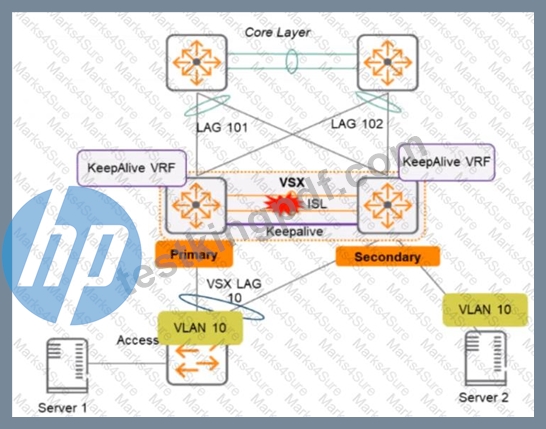
What is correct about access from the servers to the Core? (Select two.)
- A. Server 2 cannot access the core layer.
- B. Server 1 can access the core layer on only one uplink
- C. Server 2 can access the core layer via the keepalive link
- D. Server 1 and Server 2 can communicate with each other via the core layer
- E. Server 1 can access the core layer via both uplinks
- F. Server 1 can access the core layer via the keepalrve link
Answer: D,E
Explanation:
Explanation
These are the correct statements about access from the servers to the Core when the ISL link between the switches fails, but the keepalive interface functions. Server 1 can access the core layer via both uplinks because it is connected to VSX-A, which is still active for VLAN 10. Server 2 can also access the core layer via its uplink to VSX-B, which is still active for VLAN 10 because of Active Gateway feature. Server 1 and Server 2 can communicate with each other via the core layer because they are in the same VLAN and subnet, and their traffic can be routed through the core switches. The other statements are incorrect because they either describe scenarios that are not possible or not relevant to the question. References:
https://www.arubanetworks.com/techdocs/AOS-CX/10.04/HTML/5200-6728/bk01-
NEW QUESTION # 48
With the Aruba CX 6200 24G switch with uplinks or 1/1/25 and 1/1/26, how do you protect client ports from forming layer-2 loops?
- A. int 1/1/1-1/1/28. loop-protect
- B. int 1/1/1-1/1/28. loop-guard
- C. int 1/1/1-1/1/24, loop-protect
- D. int 1/1/1-1/1/24. loop-guard
Answer: C
Explanation:
Explanation
The command loop-protect enables loop protection on each layer 2 interface (port, LAG, or VLAN) for which loop protection is needed. Loop protection can find loops in untagged layer 2 links, as well as on tagged VLANs.
NEW QUESTION # 49
Which statements regarding 0SPFv2 route redistribution are true for Aruba OS CX switches? (Select two.)
- A. The "redistribute connected" command will redistribute all connected routes for the switch except local loopback addresses.
- B. The "redistribute static route-map connected-routes" command will redistribute all static routes with a matching permit in the route map "connected-routes-
- C. The "redistribute connected" command will redistribute all connected routes for the switch including local loopback addresses
- D. The "redistribute static route-map connected-routes" command will redistribute all static routes without a matching deny in the route map "connected-routes".
- E. The "redistribute ospf" command will redistribute routes from all OSPF V2 and V3 processes
Answer: B,C
Explanation:
Explanation
These are two correct statements regarding OSPFv2 route redistribution for Aruba OS CX switches. Route redistribution is a process that allows routes from one routing protocol or source to be injected into another routing protocol or destination. OSPFv2 is a link-state routing protocol that supports route redistribution from various sources, such as connected, static, BGP, etc. The "redistribute connected" command will redistribute all connected routes for the switch, including local loopback addresses, into OSPFv2. The "redistribute static route-map connected-routes" command will redistribute all static routes that have a matching permit statement in the route map named "connected-routes" into OSPFv2. The other statements are incorrect because they either do not reflect the correct behavior of route redistribution commands or do not exist as valid commands.
References: https://www.arubanetworks.com/techdocs/AOS-CX/10.04/HTML/5200-6728/bk01-ch02.html
https://www.arubanetworks.com/techdocs/AOS-CX/10.04/HTML/5200-6728/bk01-ch03.html
NEW QUESTION # 50
Describe the difference between Class of Service (CoS) and Differentiated Services Code Point (DSCP).
- A. They are similar and can be used interchangeably.
- B. CoS is only used to determine CLASS of traffic DSCP is only used to differentiate between different Classes.
- C. CoS has much finer granularity than DSCP
- D. CoS is only contained in VLAN Tag fields DSCP is in the IP Header and preserved throughout the IP packet flow
Answer: D
Explanation:
Explanation
CoS and DSCP are both methods of marking packets for quality of service (QoS) purposes. QoS is a mechanism that allows network devices to prioritize and differentiate traffic based on certain criteria, such as application type, source, destination, etc. CoS stands for Class of Service and is a 3-bit field in the 802.1Q VLAN tag header. CoS can only be used on Ethernet frames that have a VLAN tag, and it can only be preserved within a single VLAN domain. DSCP stands for Differentiated Services Code Point and is a 6-bit field in the IP header. DSCP can be used on any IP packet, regardless of the underlying layer 2 technology, and it can be preserved throughout the IP packet flow, unless it is modified by intermediate devices.
References:
https://www.cisco.com/c/en/us/td/docs/ios-xml/ios/qos/configuration/15-mt/qos-15-mt-book/qos-overview.html
https://www.cisco.com/c/en/us/support/docs/lan-switching/8021q/17056-741-4.html
https://www.cisco.com/c/en/us/support/docs/quality-of-service-qos/qos-packet-marking/10103-dscpvalues.html
NEW QUESTION # 51
Due to a shipping error, five (5) Aruba AP-515S and one (1) Aruba CX 6300 were sent directly to your new branch office You have configured a new group persona for the new branch office devices in Central, but you do not know their MAC addresses or serial numbers The office manager is instructed via text message on their smartphone to onboard all the new hardware into Aruba Central What application must the office manager use on their phone to complete this task?
- A. Aruba Onboard App
- B. Aruba Central App
- C. Aruba installer App
- D. Aruba CX Mobile App
Answer: C
Explanation:
Explanation
Aruba Installer App is a mobile app that simplifies site installations and enables network connectivity for Aruba devices. The app allows the user to scan the barcode of the device and add it to the network using Aruba Central. The app also automates importing Aruba devices into Aruba NetEdit for intelligent configuration management and continuous conformance validation
NEW QUESTION # 52
With the Aruba CX 6000 24G switch with uplinks of 1/1/25 and what does the switch do when a client port detects a loop and the do-not-disabie parameter is used?
- A. An event log message is created.
- B. Port status led blinks in amber with 100hz.
- C. The network analytics engine is triggered.
- D. Port status will be validated once status is cleared
Answer: A
Explanation:
The correct answer is B. An event log message is created.
The do-not-disable parameter is used to prevent the switch from disabling the port when a loop is detected by the loop-protect feature. Instead, the switch will generate an event log message that indicates the port number and the VLAN ID where the loop was detected. The switch will also send a trap to the SNMP manager, if configured1.
The other options are incorrect because:
A) Port status will not be validated once status is cleared. The port will remain enabled even if a loop is detected, unless the loop-protect action is changed to tx-disable or tx-rx-disable1.
C) The network analytics engine will not be triggered by a loop detection. The network analytics engine is a feature that allows users to monitor and troubleshoot network issues using scripts and agents2.
D) Port status LED will not blink in amber with 100Hz. The port status LED will indicate the normal port status, such as link speed and activity, regardless of the loop detection3.
NEW QUESTION # 53
Your manufacturing client is having installers deploy seventy headless scanners and fifty IP cameras in their warehouse These new devices do not support 802 1X authentication.
How can HPE Aruba reduce the IT administration overhead associated with this deployment while maintaining a secure environment using MPSK?
- A. Have the installers generate keys with ClearPass Self Service Registration.
- B. Have the MPSK gateway derive the unique pre-shared keys based on the MAC OUI.
- C. MPSK Local will allow the cameras to share a key and the scanners to share a different key
- D. Use MPSK Local to automatically provide unique pre-shared keys for devices.
Answer: D
Explanation:
MPSK Local is a feature that can reduce the IT administration overhead associated with deploying devices that do not support 802.1X authentication while maintaining a secure environment. MPSK Local allows the switch to automatically generate and assign unique pre-shared keys for devices based on their MAC addresses, without requiring any configuration on the devices or an external authentication server. The other options are incorrect because they either require manual intervention by the installers or the MPSK gateway, or they do not provide unique pre-shared keys for devices. Reference: https://www.arubanetworks.com/techdocs/AOS-CX_10_08/UG/bk01-ch05.html https://www.arubanetworks.com/techdocs/AOS-CX_10_08/UG/bk01-ch06.html
NEW QUESTION # 54
......
The Aruba Certified Campus Access Professional certification is highly valued by organizations that use Aruba technology. Aruba Certified Campus Access Professional Exam certification validates an individual’s expertise in configuring and managing wireless networks using Aruba products. Additionally, individuals who hold this certification are equipped with the necessary skills to troubleshoot and resolve complex network issues. The HPE7-A01 exam covers topics such as RF planning, network design, wireless standards, and security protocols.
Achive your Success with Latest HPE7-A01 Exam: https://www.testkingpdf.com/HPE7-A01-testking-pdf-torrent.html
Achieve The Utmost Performance In HPE7-A01 Exam Pass Guaranteed: https://drive.google.com/open?id=1bOiSIvQZcrkV0AIyu3L4f4sONfyLiGlQ
